24 April 2011

The Museum Without Walls

This weekend I traveled to Gyeongju ( 경주 ), which was the capital of the Silla Kingdom from 57 BC until the fall of the kingdom in 935 AD.  It turns out that serving as a capital city for almost one thousand years provides quite a few tourist attractions.  Gyeongju is home to 31 national treasures, 35 royal tombs and 2 Unesco World Heritage sites.  As far as tourist destinations go, it packs a pretty powerful punch for a city of only 260,000 people.  The sites in the city itself are all within walking distance of each other and the sites outside of the city are easily accessible by bus.  It certainly lives up to its reputation as the "museum without walls".  Unfortunately, it's a pretty expensive museum as you have to dish out a couple thousand won for almost every site (the museum itself is actually one of the only things you don't have to pay for).

Gyeongju is only about an hour bus ride from Daegu, so I ended up arriving at my destination around 10:30.  I started my touring at Bulguksa ( 불국사 ), which is one of the most famous temples in Korea and is considered to be the best example of Silla architecture.  The temple was completed in 774 AD and is still a functioning temple.  The temple is on the Unesco World Heritage list, is home to seven national treasures and is arguably the most well-known temple in Korea. 

The gate is called Anyangmun ( 안양문 ), the upper half of the stairs is Chilbogyo ( 칠보교 ) and the lower half is called Yeonhwagyo ( 연화교 )
From left to right: Seokgatap ( 석가탑 ), Daeungjeon ( 대웅전 ), and Dabotap ( 다보탑 )
Gwaneumjeon (관음전 )
Remains of Beohwajeon ( 법화전 )
I spent about an hour or so wandering around Bulguksa before I decided to begin the 2.2 km hike from Bulguksa to Seokguram Grotto.  Seokguram Grotto ( 석굴암 ) was placed on the Unesco World Heritage list along with Bulguksa and is home to an extremely famous Buddha statue.  Seokguram was also completed in 774 AD and was built without the use of mortar.  Instead, the stones are simply held together with rivets.   Unfortunately, I couldn't take a picture of the Buddha statue, but it's pretty impressive and you can just Google it if you're interested.  On the plus side, I had the good fortune of finding the place decorated for Buddha's birthday.   

Lanterns for Buddha's Birthday
Bell Tower outside of Seokguram
After checking out the grotto I reversed course and hiked back down to Bulguksa.  From Bulguksa I caught the bus back to downtown Gyeongju and got ready to check out the sites within the city.  Although the sites in the city have not been individually named to the Unesco World Heritage list, they have collectively been placed on the list along with the historical sites on Namsan (which is right outside of the city). 

Outside of Bulguksa
Flowers in full bloom
Now it was time to check out Tumuli Park ( 대릉원 ), which is home to 23 tombs.  Silla buried their dead kings and nobles in huge earthen tombs.  Some of the tombs approach 50 feet in height and are pretty impressive when all grouped together.  The most famous of these tombs is Cheonmachong ( 천마총 ), which was excavated in the 1970s and provided the only known extant painting from the Silla era.  

Pond and one of the earthen tombs
Next on the agenda was Wolseong Park.  The oldest surviving astronomical observatory in the East Asia is the main draw to this park.  The observatory is called Cheomseongdae ( 첨성대 ), which appropriately means "Star-gazing Tower", and dates to the 7th century AD.  The 366 stones used to make the tower are supposed to represent the length of a year (I guess they round up), the 27 layers of stones are supposed to honor Queen Seondeok, who was the 27th ruler of Silla, and the 12 base stones are meant to represent the months.  The observatory does not look like an extremely functional building, but I guess it served its purpose in the 7th century.  After checking out the observatory I headed to the middle of the park where a performance was taking place.  I was befriended by an old Korean man who attempted to tell to me about the festival and invited me to drink some tea with his friends.  I had a hard time understanding too much of what he was saying, but I did find out that the performers were wearing traditional Silla attire and that one part of the festival displayed the tea-making process.  He then brought me over to the mochi making exhibition.  Mochi is made of glutinous rice and in Korea is usually used to make ddeok ( 떡 ), which is a rice cake.  The traditional tools for making these consisted of a wooden bowl and a large wooden mallet.  As you might be able to assume, the mochi is placed in the bowl and then hit with the mallet.  I got a couple of swings at it.

Cheomseongdae
Making mochi
 After my cooking lesson I moved onto Anapji ( 안압지 ).  Anapji is an artificial pond ("ji" means pond) that was part of the palace complex and was constructed in 674 AD.  The pond is particularly famous for the incredible number (around 33,000) of historical relics that were excavated at the site in the 1970s and 1980s.

Anapji
On to my last stop of day: Gyeongju National Museum.  This is a pretty spectacular museum that I personally found to be more interesting than the National Museum of Korea in Seoul.  In comparing the two museums, let's start with the architecture.  Seoul's museum is housed in a modern building that, while beautiful in its own right, doesn't quite do justice to a museum based on Korean history.  Gyeongju's museum on the other hand, does an amazing job of meshing traditional Korean architecture with modern building materials.  Honestly, I really couldn't think of a more fitting design for the museum.  As for the historical artifacts, the Three Kingdoms Period is my favorite time period in Korean history, so having a museum solely dedicated to one of the kingdoms certainly wasn't a problem for me.  With that said, someone who is looking simply for a broad overview of Korean history may be better served by Seoul's museum.

The museum consists of four separate exhibition halls as well as an outdoor display.  The halls are as follows: Archeology Hall, Art Hall, Anapji Hall, and another one that I believe changes its theme from time to time.  The fourth hall is currently showcasing items from the Vietnamese Nguyen Dynasty.  The museum apparently houses over 80,000 relics, of which only 2,500 can be displayed at any one time.  The most famous item is the Emile Bell.  The bell, also known as the Divine Bell of King Seongdeok, was cast in 711 AD and weighs in at a whopping 18.9 tons, making it the largest bell in Asia.  The name "Emile Bell" comes from a legend that when the bell was first made it would not ring so it was melted down to be recast.  The head priest then threw a child into the molten pit and when the bell was finally recast the sound it made was "Emi, emi, emi, emile", which means "Mommy, mommy, mommy, for your sake".

Outside
Emile Bell
Replica of Dabotap and Art Hall
Seokgatap, Archeology Hall, and Dabotap

Special Exhibition Hall
Vietnamese throne
Wow

Art Hall
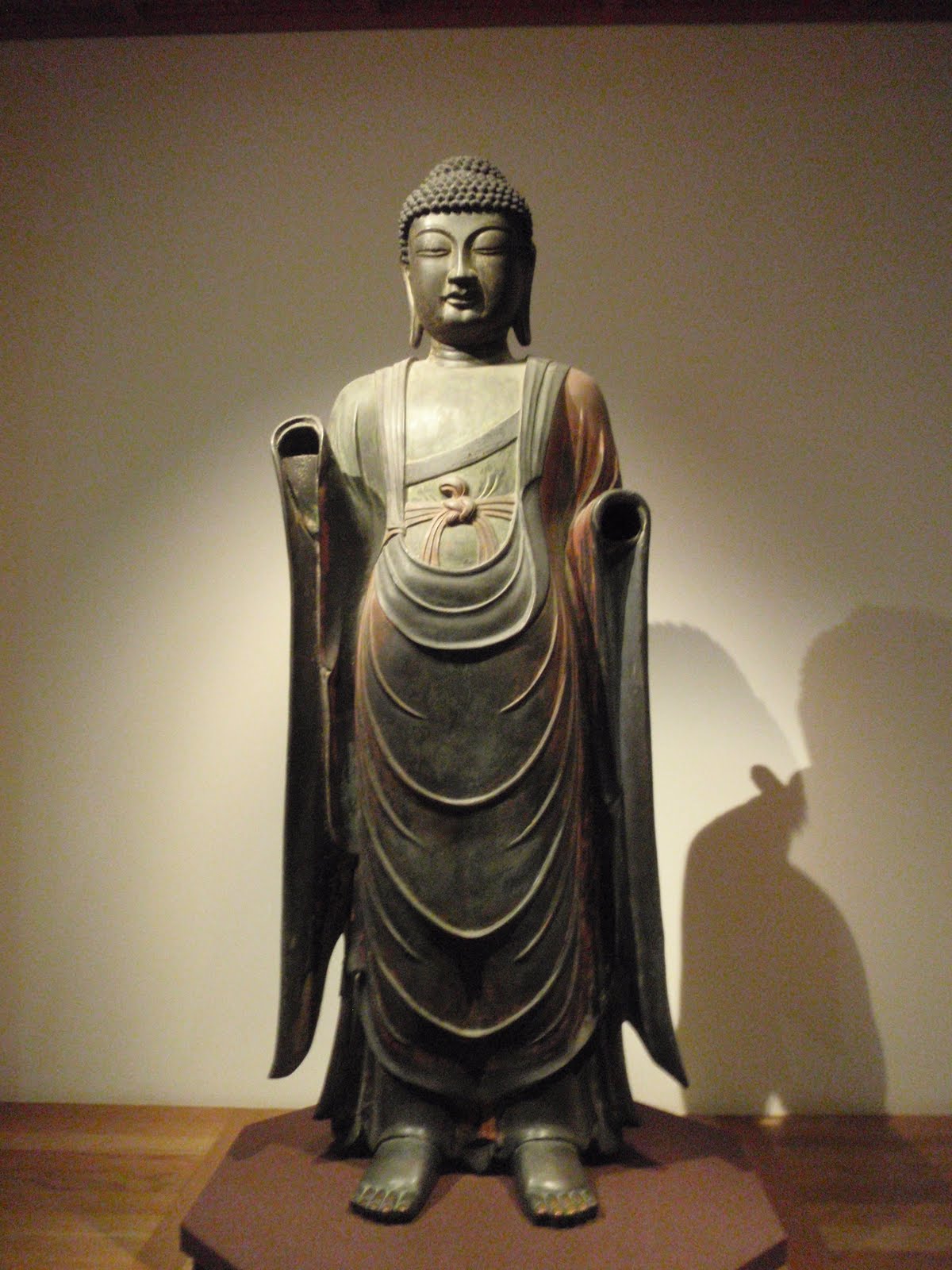
Bhaisajyaguru Buddha - 8th century

Archeology Hall
Silla crown
Daggar and gold scabbard - 6th century

Anapji Hall
Roof tile
I took another stroll through Wolseong Park on my way back and got some pictures of the Rape fields.  Ya, I was a little perplexed by the name too.  The word "Rape" refers to Rapeseed, which is a plant that produces bright yellow flowers. 

Sun going down over the rape fields
On to Day 2.  Not quite as exciting as the first day, but interesting nonetheless.  For one, I got completely lost, so I spent a little time exploring the "real" Gyeongju as I guess people would call it.  But I finally found my way to my destination, which was Bunhwangsa ( 분황사 ) and its neighbor, Hwangnyongsa ( 황뇽사 ).  Hwangnyongsa is only ruins, but there were Rape fields covering a lot of the ground around the temple and that, along with the beautiful mountain backdrop, made for some good pictures.  The main attraction at Bunhwangsa is Bunhwangsa Pagoda ( 분황사석탑 ).  This is the oldest dated pagoda from the Silla Kingdom and while today it is only three stories, it is believed to have been between seven and nine stories tall.

At Hwangnyongsa
Bunhwangsa Pagoda
And that about wraps it up.  I ended up catching a bus home around noon.  There is still a lot of stuff to see in Gyeongju and I'll be heading back at least one more time.  I would like to hike around Namsan (mountain) and I would also like to visit King Munmu's underwater tomb.

12 April 2011

Goryeo: Military and Mongols (1170 - 1392)

The aristocratic fat cats were about to pay a dire price for their disregard, and in many cases flat out disrespect, for the military officers of their day.  Military commanders and civil officials had previously held a similar social standing, but the rise of the aristocratic order had placed the military officials in an inferior position to their aristocratic counterparts.  Civil officials slowly began to fill military positions at the beginning of the twelfth century, but it wasn't until the reign of Uijong ( 의종 ), who ruled from 1146 until 1170, that the rage of the military finally reached its breaking point.  There were two particularly insulting events which directly contributed to the military revolt.  The first of these occurred at Uijong's royal banquet in 1167.  At this event, Kim Donjung ( 김돈중 ), who was the son of the famous Kim Busik and an advisor to Uijong, set fire to the beard of an officer named Jeong Jungbu ( 정중부 ) and then proceeded to mock him and the entire military.  The final straw however, took place in 1170 when General Yi Soeung, who at the time was around 50 years old, was defeated in a martial arts competition by a much younger soldier.  Following the event, a civil official name Han Roe began to insult the general and even slapped him in the face.  Although the result was not immediate, this was the last in a series of disrespectful events that caused Jeong Jungbu, Yi Uibang ( 이의방 ), Yi Go ( 이고 ) and other military officials to rise up against the government.


Military Rule
"Death to all who but wear the civil official headdress!"
This was the rallying cry that united the military in their opposition to the civil officials.  It goes without saying that the unified military force was easily able to massacre the defenseless civil officials (Kim Donjung and Han Roe of course met their end).  One of the remaining aristocrats attempted to restore Uijong to power (he had been sent into exile following the rebellion) in 1173, but this attempt failed and resulted in the death of Uijong and another purge of civil officials.

Military Might
The three leaders of the military revolt placed Myeongjong ( 명종 ) on the throne following the rebellion, but he was merely a puppet and the real power was held by the military.  Unfortunately, as is usually the case with military regimes, the only thing that mattered during this time period was military might.  This resulted in a very tumultuous time period in which power constantly shifted amongst the most powerful military officials.  The first of the leaders to go was Yi Go, who was killed by Yi Uibang in his attempt to garner power.  However, Yi Uibang was later killed by supporters of Jeong Jungbu, who was then later killed by General Gyung Daeseung ( 귱대승 ) in 1179.  Gyung Daesung became ill and died in 1183 and power then passed to a former slave named Yi Uimin ( 이의민 ).  Yi Uimin proved to be a ruthless dictator and was finally killed in 1196.  Yi Uimin's death, and the subsequent rise to power of Choe Chungheon ( 최충헌 ), finally brought an end to nearly three decades of political turmoil in Goryeo

Reform
Choe Chungheon may have brought some order and stability to Goryeo, but he by no means was a benevolent ruler.  He disposed of all who disobeyed his orders and asserted his supremacy over the throne by placing four different kings upon it.  It should be noted that he did not do away with the monarchy, but simply removed all of its power and took it for himself.  Choe also focused his attention on two other power struggles at the time.  He asserted his power over the Buddhist monks by forcing them out of the capitol and destroying any of those who opposed with his powerful military.  He also subdued many peasant uprisings through the use of military force or in some instances political appeasement.  Choe's power was later solidified by Choe Chungheon's son, Choe U ( 최우 ).  Choe U succeeded in creating a personal military and elite patrols to safeguard Choe's hold on power.  He also created political offices through which he could wield power over the throne.

Uprising
One of the unintended consequences of the military revolt was the spread of insurgency throughout the peninsula.  Social order had prevailed in Korea since time memoriam, but the rise of military officials to the highest government offices introduced doubts to this previously hierarchical society.  If the military officials could ascend the social ladder, why not the peasants?  Peasant uprisings began in 1172, but it wasn't until 1193 that the movement really caught fire.  Rebel bands of peasants were a harsh reality for the new military regime during the end of the twelfth and the beginning of the thirteenth centuries.  And while the Choe regime succeeded for the most part in subduing these rebellions (some of which numbered in the tens of thousands), it became evident during this time period that the previously rigid social structure in Korea had become an artifact of a bygone era. 


Mongol Invasions
Working Together
Well this didn't last too long, but Goryeo and the Mongols actually joined forces for a short period of time in their mutual quest to destroy the Khitan.  The Mongols succeeded in forcing the Khitan into Goryeo territory and it was at this point that Goryeo and the Mongols teamed up.  The Khitan eventually fell to the Mongol-Goryeo alliance in 1219.  This however would prove to be the first and last cooperative effort between these two nations.

Resistance
The Mongols began to demand tribute from Goryeo after the defeat of the Khitan and the increasingly unstable relationship between the two countries finally came to a head when the Mongols launched their first invasion in 1231.  The two countries came to an agreement and ended the first invasion, but the agreement stipulated that Mongol governors would be placed in the northwest portion of Goryeo.  However, Choe U decided to resist the Mongols and moved the capitol to Ganghwa Island.  The Mongols were not very happy about this move and subsequently launched five more invasions of Goryeo over the next thirty years.

The Peasants
The military was not the only body resisting the Mongol invasions.  The peasants also rose up in rebellion against their invaders.  And it was the peasants who bore the brunt of the Mongol's wrath.  While Goryeo's leaders enjoyed lives of luxury and safety on Ganghwa Island, the peasants fought tooth and nail for their country and were slaughtered by the Mongols as a result. 

End of Military Rule
The Choe military regime was completely satisfied resisting the Mongols from their stronghold on Ganghwa Island.  In contrast, the civil officials advocated for capitulation.  The last of the Choe dictators, Choe Ui ( 최의 ), was assassinated in 1258.  Some advocates of resistance remained for the next twelve years, but the policy of resistance was for the most part abandoned and in 1270 Goryeo returned its capital to Gaeseong and completely succumbed to Mongol rule.

Mongol Control
Yuan's (the Mongols named themselves the Yuan Dynasty) first order of business for its newly acquired vassal state was to utilize Goryeo's location and military strength as a springboard for an invasion of Japan.  The Mongols launched campaigns into Japan in 1274 and 1281, but both ended in failure.  Goryeo was allowed to maintain its sovereignty and continue the line of the royal house, but all of the monarchs during this period were ultimately controlled by Yuan.  In addition to asserting its dominance over the royal house, Yuan also demanded a substantial amount of tribute from Goryeo.  Yuan's demands obviously led to a rift between the two countries and Goryeo jumped at its first opportunity to rid itself of Mongol control.


The End is Near
Decline of Yuan
Goryeo's opportunity to expel Yuan's influence from the peninsula arose during the reign of King Gongmin ( 공민왕 ), who ruled from 1351 until 1374.  The upstart Ming dynasty had succeeded in forcing the Mongols to retreat to the north and Gongmin used this opportunity to remove Yuan's influence on the peninsula, purge the government of any Yuan supporters, and regain the land lost during the Mongol invasions.  These changes opened the door for a large scale shift in Goryeo's government.  After all, the royal house had not held any actual authority for almost 200 years.  Yi Seong-gye ( 이성계 ) appeared to be just the man for the job. 

Yi Seong-gye
Yi Seong-gye began his political career as a strong military commander responsible for warding off the incessant attacks of Japanese marauders.  His entrance into politics came about as a result of King U's ( 우왕 ) decision to invade the Ming dynasty.  Yi Seong-gye opposed the decision, but was entrusted with control of the military campaign.  However, instead of following orders, Yi Seong-gye decided to reverse course and instead attack the capital, overthrow the king, and seize power for himself.  Although it would be another three years until the official establishment of the Joseon Dynasty, for all practical purposes this event brought an end to the Goryeo Dynasty.


Culture
Emergence of the Literati
A new class named the literati (similar to the term "scholar"), which would eventually become the dominant social class in Korea, emerged during this time period.  The literati was composed of educated men who supported an examination system as opposed to the traditional system of advancement based upon lineage.  Many of these men also came from outside the capitol and owned small portions of land. 

Neo-Confucianism and the Decline of Buddhism
Confucianism and Buddhism had previously succeeded in coexisting on the Korean peninsula for hundreds of years, but the advent of Neo-Confucianism during the fourteenth century put an end to the previously peaceful relationship between the two modes of thought.  Neo-Confucianism attempted to explain the origins of man and of the universe, which was an area of thought previously reserved for Buddhism.  Similar to the modern conflict between science and religion, this discrepancy between Neo-Confucianism and Buddhism eventually led to a decline in Buddhism on the peninsula.

Writing
Kim Busik's compilation of Korean history, which was known as the Samguk sagi and released in 1145, ignited a fascination with Korean history.  As a result, many history books were written during this period.  The most notable of these is the Samguk yusa, which like the Samguk sagi focuses on the Three Kingdoms Period, but rather than focusing on "facts", it instead investigates myths and beliefs during the time period. 

Art
The most notable artistic achievements from this time period are the wooden structures.  Not because they were particularly exquisite, but because they are the oldest extant examples of wooden architecture in Korea.  The oldest of these can be found in modern-day Andong.  Wood has proven itself to be a very ineffective medium in Korea due to numerous invasions, which are the main reason that wooden buildings from previous time periods no longer exist.

Technology
Movable metal type was invented in Goryeo, which obviously paved the way for the widespread publication of books.  The other major advance in technology was the introduction of gunpowder, which was passed to Goryeo by way of the Chinese.

03 April 2011

Goryeo: Royal Authority and Aristocratic Control (936 - 1170)

We left off with Wang Geon ( 왕곤 ), later to be known as Taejo ( 태조 ), conquering Baekje and accepting the surrender of Silla in his quest to unite the Korean Peninsula.  The next phase of Korean history takes place under the reign of the Goryeo Dynasty, which ruled the Korea from 936 until 1392.  I am going to split this history into two parts, the first of which will cover Goryeo's history until 1170, which is the year that a military revolt took place within the empire.  So without further ado, let's delve into the first 234 years of Goryeo's unification of Korea.


The Growth of Royal Authority
The collapse of centralized power ultimately led to the undoing of the Silla Kingdom and Wang Geon was determined to avoid Silla's fate.  He established marriage ties with over twenty gentry families around Goryeo's capital of Songak and also provided positions for nobles from the fallen kingdoms of Balhae, Later Baekje, and Silla.  Wang Geon died in 943 and the years following his death were turbulent times marked by the Wang Gyu ( 왕규 ) rebellion and the extremely short reigns of the next two monarchs.  Clans were still very powerful at this point and it would take an equally powerful ruler to break the clans' hold on the Korean peninsula.

Gwangjong ( 광종 ) took the throne in 949 and began his attempt at establishing royal authority by enacting the Slave Review Act, which decreased the number of slaves owned by military commanders and local gentry and in turn also decreased their power.  He also created a civil service examination, which promoted people based upon skill rather than lineage.  He then began to call Gaegyeong (the name of the capital at that time) the "Imperial Capital" and the terms "Your Imperial Majesty" and "High King" came into use.  Understandably, the previously powerful military commanders and civil officials objected to these reforms and the end result of this discontent was a merciless purge by Gwangjong.  Anyone who refused to submit to royal authority met their ultimate demise.  Gwangjong's successor, Gyeongjong, also attempted to strengthen the throne by establishing the Stipend Land Law, but it would not be long before the Aristocrats fought back.


Establishment of the Aristocratic Order
Aristocrats still held a very important place in Goryeo's society and they were constantly trying to improve their social position through the use of marriage ties.  Marriage ties allowed families, in particular the the Kim family from Ansan and the Yi family from Inchon, to dominate power for extended periods of time.  The Kim family held power through marriage ties to the royal family from 1009 until 1046 and the Yi family was a political force from 1046 until 1122.

This inevitably led to a new political structure which was completed in 1076 and of course placed more emphasis on the aristocracy.  There were numerous political offices created for the aristocracy, the most interesting of which was the Surveillance Chancellery, whose primary responsibility was restraining royal authority. 


Goryeo-Khitan Wars
The Liao Dynasty, made up of the Khitan people, was located in Manchuria and began near the end of the Balhae Kingdom in 916.  As stated in the post on the Later Three Kingdoms, Balhae was defeated by the Khitan in 926 and Khitan went on to become the chief opponents to Goryeo in the early years of its empire. 

The First Goryeo-Khitan War
The first conflict occurred in 993 when the Khitan invaded Goryeo with 60,000 troops.  The conflict was short-lived and the Khitan withdrew its forces when Goryeo agreed to end its alliance with the Song Dynasty in China.


The Second Goryeo-Khitan War
The Khitan attacked again in 1010 and succeeded in occupying the Goryeo capital and forced King Hyeonjong to flee.  However, the Khitan became fearful that their supply lines would be disrupted and decided to once again withdraw their troops.

The Third Goryeo-Khitan War
The final attack by the Khitan occurred in 1018 after Goryeo's refusal to cede territory and submit to their rule.  The Khitan attacked with approximately 100,000 troops, but Goryeo countered with over twice that amount.  The Khitan suffered a significant defeat and a peace treaty was eventually signed four years later.


Problems with the Aristocratic Order
The aristocracy continued to consolidate power for the next hundred years, but power struggles arose amongst the ruling clans.  The rule of Injong ( 인종 ), which lasted from 1122 until 1146, was particularly marred by these power struggles.  The first man to vie for power was named Yi Ja-gyeom, who was the father of two of Injong's queens.  He held political power during the beginning of Injong's rule, but ultimately desired to usurp the throne.  He attempted a moderately successful coup in 1126, but Injong was able to regain power in 1127 and Yi Ja-gyeom was banished from the capital.

The second revolt during Injong's reign occurred in 1135 and was led by a Buddhist monk named Myo Cheong.  Myo Cheong had previously advised Injong to move the capital to modern-day Pyongyang in an attempt to seize the power of the throne.  He also wanted Injong to attack the Jurchens (who were located in Manchuria), but Injong refused and as a result Myo Cheong raised an army in Pyongyang and created his own state.  The insurrection was short-lived, but it once again demonstrated the decrease in royal authority.

The increase in aristocratic power resulted in a great divide between civil officials and military commanders.  The civil officials lived lives of luxury, while military officers were repeatedly forced to suffer indignities, usually at the hands of civil officials.  This situation of course could not last and the military commanders finally revolted in 1170.  The military was united in the cause and civil officials were massacred during the uprising.  Some civil officials later attempted to regain power, but the damage had been done and control of the Goryeo Kingdom had officially been passed to the military.


Culture and Society
Buddhism
The Seon School and the Gyo School were the two primary modes of thought within Buddhism during this time period.  The Cheontae School later arose as a way to reconcile the differences between Seon and Gyo.  Despite the rise of Confucianism during the Goryeo Dynasty, it remained a thoroughly Buddhist state.

Coffin with the four guardian deities
Confucianism
Confucian ideology prospered under aristocratic rule and the introduction of state examinations provides ample evidence of the power that Confucianism wielded over Goryeo.  This time period was marked by a more rational approach to contemporary problems.  Confucianism would one day be used to suppress Buddhism, but during this time period both thought processes coexisted. 

Literature
The most impressive work produced was the Buddhist Tripitaka, which consisted of Buddhist scriptures printed on woodblocks.  This project was undertaken as a prayer for the purpose of bringing an end to the Khitan invasions.  Unfortunately, the original Tripitaka was destroyed during the Mongol invasions during the thirteenth century, but it was later remade and the extant version is generally regarded as the finest collection of Buddhist scriptures in East Asia.

Art
Goryeo's celadon ware is the finest example of the dynasty's cultural achievements.  Goreyo celadon was utilized to make numerous items and was influenced primarily by natural themes.  The celadon ware is said to display Goryeo's appreciation for elegance, while also expressing its grace and charm.

Goryeo celadon
Education
A huge change in the educational system took place with the establishment of the National University in 992.  The university consisted of six colleges and the entrance requirements for each college were dependent upon lineage.  University College, High College and Four Portals College emphasized study of the Chinese tradition and were the most exclusive schools.  The Law College, the College of Calligraphy, and the College of Accounting were available to the lower levels of the aristocracy and to the commoners.  While this was a huge step forward for the educational system, it was not until the reign of Injong (1122-1146) that schools were set up outside of the capital and education started to become more widespread.

Shinto ( 神道 )

Well I'm not quite through my book (or my blog posts) on Korean history, but I've already started investigating Japanese history and I think that a thorough understanding of Japan's indigenous belief system is essential for a complete comprehension of Japanese culture and history.

Torii at Itsukushima Shrine
As a side note: I'm pretty good at reading Korean, but I'm not very familiar with Japanese, so if anyone who reads this sees any problems with the translations or with the Japanese characters please let me know.

Shinto ( 神道 ), also known as kami-no-michi, translates to "the way of the gods".  Shinto appears to have originated around 500 BC, but the first documentation of the legends can be found in the Kojiki ( 古事記 ), which means "Record of Ancient Matters" and was written in 712 AD.   The first logograph (the term comes from the Greek "logos", meaning "word", and "grapho", meaning "to write") is "Shin" and means "kami" or "gods".  The second logograph is "to", which stems from the Chinese term "tao", meaning the path or the way.  So basically, Shinto is the way of the gods.  However, the term "gods" in the western sense of the word isn't really the most accurate translation.  For starters, the gods as a whole are known as yaoyorozu-no-kami ( 八百万の神 ).  This term literally translates to "eight million kami", but is understood as a numerical representation for infinity.  Kami can take the form of actual material beings (natural or man-made) or the qualities that an object possesses.  Like the western idea of gods, kami are supernatural forces that are above the thoughts of man, can respond to prayers, and can influence the course of events on earth.  Kami are also a part of everything on earth and there exists both good and evil kami.  However, there are some major differences between "kami" and "gods".  Kami are not omnipotent, they are not perfect, and while they may be supernatural beings, they do not exist in a supernatural universe.  Kami is both the spirit that dwells within all things and also the things themselves.  The following is summary of the most well-known kami:
  • Izanagi ( 伊弉諾 ) - Male deity, who along with Izanami, created the islands of Japan
  • Izanami ( 伊弉冉尊 ) - Female deity, who created the islands of Japan with Izanagi, her husband and brother
  • Amaterasu ( 天照 ) - Sun goddess, ancestor of the Imperial family, and greatest of the kami
  • Tsukuyomi ( 月読命 ) - Moon kami who rules over the night
  • Susanowo ( 須佐之男 ) - Brother of Amaterasu and Tsukuyomi who controls the storms and the seas
  • Hachiman ( 八幡神 ) - Guardian of warriors and protector of Japan
As is the case with almost every "religion", Shinto has its own creation myth:
     In the beginning, the universe (really just the earth) was shapeless.  However, the particles began to move and since the light particles were the fastest, they reached the highest point in the sky.  The particles first formed the clouds, then Heaven (known as Takamagahara, or 高天原), and then finally Earth.  There were then five gods formed spontaneously, none of whom had a gender or a partner, and all of which subsequently went into hiding and were never heard from again.  Two more sexless gods were spontaneously created and then five pairs (male and female) of gods were born and the last of these gods were Izanagi and Izanami.  These two gods were given a spear, which they dipped into the ocean, and when they took it out the drops of water from the spear formed the islands of Japan.  They then descended from Heaven and gave birth to kami.  Unfortunately, Izanami died while giving birth to Kagutsuchi ( 迦具土神 ), the kami of fire.  Amatersau was then born out of Izanagi's left eye, Tsukiyomi was born out of his right eye, and Susanowo was born from his nose.
Kushida Shrine decorated for the new year
Notice in the previous paragraph that I put the word "religion" in quotes.  This is because it doesn't really apply to Shinto, but as was the case with the words "gods" and "kami", it is probably the closest word that we have to describe it.  Shinto involves many rituals and really infiltrates every aspect of Japanese society.  But my problem with calling it a religion stems from the fact that it has coexisted with Buddhism for almost 1,500 years.  By coexistence I do not mean that half of the population practiced one religion, while the other half practice another.  I mean that people generally have no problem following both ideologies.  As of 1999, 83% of Japanese citizens followed Shinto and 76% adhered to Buddhism.  There's obviously some overlap there.  Coexistence cannot occur with two separate religions.  Have you ever met a Muslim-Jew?  Or a Christian-Hindu?  It just doesn't work.

Buddhism and Shinto are able to compliment each other very well primarily because Shinto is not a religion of absolutes.  Shinto also does not sufficiently address death or the afterlife.  Buddhism has always taken precedence in regard to funerals and the afterlife, so there hasn't been much of an incentive to develop the ideas within the Shinto ideology.  Neither "The Dark Land" nor "The High Plain of Heaven" are adequately addressed, so while it shares many attributes with the western idea of religion, its exclusion of any explanation about life beyond this world seems to separate Shinto from what we have come to view as religion.  How exactly do they reconcile the differences between the two thought processes you might ask?  Well as an example, within Buddhism the kami are viewed as manifestations of Buddhas and Bodhisattvas, and in Shinto the Buddha is seen as yet another kami.  The ideologies have been able to coexist since 552 AD and this intermingling of thoughts has created a truly unique Japanese viewpoint on life and the afterlife.

Despite the absence of absolutes in Shinto, here are some basic beliefs:
  • The Four Affirmations
  1. Tradition and the family
  2. Love of nature
  3. Physical cleanliness
  4. Matsuri - Worship of kami and ancestral spirit
  • Musubi - The mysterious and harmonizing power of kami.  The nature of kami transcends the thought process of man, but it can be viewed through the forces of nature.
  • Makoto - Translates to either "sincerity" or "true heart".  This is a principle by which all people are supposed to live their lives.
  • Tsunagari - Translates to "community" and establishes the importance of recognizing one's lineage and participating in various social groups.
  • Cyclical history - Shinto does not believe in Armageddon and views the recurrence of historical events as evidence that the world is cyclical in nature.  
  • Purity - This is generally considered the most important aspect of Shinto.  Impurity is defined as anything that separates a human from kami or musubi.  Human beings are born pure and later introduced to tsumi (pollution or sin), which makes them impure.  A major difference between tsumi and the traditional thinking on sin is that impurities can be caused by things (such as evil spirits) that are beyond the control of humans.
Hakozaki Shrine
    So how do human beings become pure again?  Ritual practices are extremely important in Shinto (they are in many ways actually the religion itself), so here are some quick points about Shinto's religious practices and some of the well-known rituals:
    • Worship should be done with cheerfulness, sincerity, and purity
    • Worship can be done on any day of the week (there isn't a holy day in Shinto) and can be practiced either in public or in private.  Worship at home takes place in front of a kamidana ( 神棚 ), or kami shelf, which can be used to present offerings to kami and to say prayers.  Public worship takes place at shrines and can be done for spiritual reasons or to make a request to the kami.
    • Omairi - Anyone, Shintoists and non-Shintoists alike, is welcome to visit Shinto shrines.  However, there are some steps that are not necessarily required for non-followers, but should be followed as a sign of respect.  
      1. Approach the entrance and bow respectfully
      2. Use a ladle at the hand washing basin to first wash your left hand, then your right hand, and then rinse your mouth (but don't swallow the water or spit back into the basin).  Then tilt the ladle backwards and use the remaining water to wash the handle before setting it back down.
      3. If offering a prayer, approach the shrine and provide a donation.  Then perform two bows followed by two claps.  After the second clap, hold your hands together in front of your heart.
    • Harae - The purification rites, which can be performed in a number of different ways.  Some notable methods include temizu (simple washing of the face and hands), Oharae (ceremony of great purification), shubatsu (sprinkling salt on priests, worshipers, or the ground for purification) and Haraigushi (a priest waves a purification wand).
    • Kagura - An ancient ritual dance
    • Jichinsai - Ceremony held before the construction of a building
    Itsukushima Shrine
    So hopefully that provided a good introduction for anyone unfamiliar with this ancient religion.  Shinto is a fascinating religion and one that cannot be fully explained in one blog post.  Further study of the religion can be accomplished by reading either the Kojiki or the Nihon Shoki.  Shinto does not have any holy scriptures, but these two books document the myths and teachings of ancient Japan.  There are many fascinating aspects to Japanese history and I am looking forward to exploring these in future blog posts.

    Hello April!

    I can't believe it's already been over four months since I left the United States.  As for my travels this weekend, I decided to take a short trip to Pohang ( 포항 ), which is located on the east coast.  I actually found my way to the easternmost point on the South Korean mainland.  This was a relatively uneventful trip as I just took a stroll along the beach before making my way to Homigot Sunrise Square.

    Walking along the coast
    I headed to Daegu after I woke up to catch a bus to Pohang, which is only about an hour and fifteen minute ride.  From Pohang I caught a bus to Guryongpo ( 구룡포 ) and rather than wait an hour and twenty minutes for the bus, I decided to take a stroll along the ocean to get to Homigot ( 호미곳 ).  Homigot is the most eastern point on the South Korean mainland and for this reason it is a very popular place to watch the sunrise.  It is particularly famous for its Sunrise Square, which features two bronze, hand-shaped statues.  One is on land and the other is in the Sea of Japan.  I wish the weather had been a little nicer so I could have gotten some better pictures, but they turned out pretty nice nonetheless.

    In the water
    Sunrise Square
    Homigot Lighthouse, which is the largest lighthouse in Korea, and the Lighthouse Museum are also located right next to the plaza.

    Homigot Lighthouse
    Overall, it was a pretty laid back day, which I think was needed after my trip to Seoraksan.  The flowers are finally starting to bloom in the southern regions of the peninsula, so I'll probably be heading down south for the next couple of weekends.  Springtime can make for some amazing pictures, so I'm really looking forward to visiting more temples over the next month or so.