13 February 2011

The Three Kingdoms Period: Goguryeo (고구려)

As is usually the case with kingdoms or states formed in the ancient era, Goguryeo's history faces a conflict between archeological findings and the traditional stories and myths concerning its founding.  The most reliable written accounts about this period in Korean history are found in the Samguk Sagi ( 삼국사기 ) and the Samguk Yusa ( 삼국유사 ).  The Samguk Sagi, or History of the Three Kingdoms, was compiled in 1145 by Kim Busik ( 김부식 ) during the Goryeo Dynasty, making it the oldest Korean historical work still in existence today.  The book is in fact a compilation, and as such, Kim Busik pulled records from numerous sources.  Specifically, he borrowed information from the Gu Samguksa ( 구삼국사 ), or Old History of the Three Kingdoms, the Hwarang Segi ( 화랑세기 ), or Annals of Hwarang, and multiple Chinese texts.  It should be noted however, that Kim Busik was commissioned by the Goryeo king to assemble the historical text.  Due to this fact, one of the main purposes of the Samguk Sagi was to assert Goryeo's right to rule the Korean peninsula, which led to distorted facts.  The Samguk Yusa, or Memorabilia of the Three Kingdoms, was assembled about 100 years later and focuses primarily on the traditions, myths, and folklore during the Three Kingdoms period. 


The Beginning: The Successor to Buyeo

Founding
According to information found in the Samguk Sagi, Samguk Yusa, and on the Stele of Gwanggaeto the Great, Goguryeo was founded in 37 BC by a Buyeo prince named Jumong ( 추몽 ), who would later come to be known as King Dongmyeong (Dongmyeongseongwang, or 동명성왕  ).  It should be noted however, that a precursor to the eventual Goguryeo state began as early as the 4th century BC.

Myth
Jumong was supposedly the son of Yuhwa ( 유화 ), who was the daughter of Habaek ( 하백 ), the god of the Yulu river.  Yuhwa was condemned to a mortal life after she disgraced her father and eventually married Geumwa (Geumwawang or 검와왕 - the "wang" title means king), who was king of Dongbuyeo (동부여, which means East Buyeo).  Yuhwa was impregnated by sunlight and gave birth to an egg, out of which Jumong was born.  Geumwa tried to destroy the egg by feeding it to animals, but the animals instead protected the egg and Geumwa later returned it to Yuhwa.  Geumwa's sons were jealous of Jumong and eventually forced him to leave Dongbuyeo.  According to the myth, he fled on horseback and when he approached a river, various animals in the water rose up and formed a bridge for him to cross.  He eventually established Goguryeo in the land to the south of Buyeo and united all of the tribes in that area.


Early Years
Goguryeo's close proximity to China, combined with a lack of resources, meant that Goguryeo was destined to become a militaristic society.  Warriors in Goguryeo completely dedicated themselves to training for combat, even in times of peace.  These highly trained warriors would prove to be very useful once Goguryeo began expansion during the beginning of the first century AD.  Goguryeo desired to expand its borders in all directions, which of course led to conflict with China.  There were numerous clashes with China during Goguryeo's early years, and these eventually culminated in a war with the Wei Dynasty in 244 AD.  Goguryeo also enjoyed frequently raiding the lands of neighboring states, which again was due to the lack of resources within Goguryeo's borders.  The states of Okjeo and Dongye came under Goguryeo's control during the reign of King Taejo ( 태조왕, or Taejowang ), who ruled from 53 to 146 AD (although the length of his reign is disputed, this 93 year reign is supposedly the second longest reign in world history).


Goguryeo-Wei Wars
Goguryeo and the Wei Dynasty were allies following the fall of the Han Dynasty in China.  However, in an apparent attempt to expand the borders of Goguryeo, King Dongcheon ( 동천왕 ) attacked one of Wei's outlying districts in 242.  This led to two campaigns by the Chinese in 244 and 245.  During the invasion in 244, the two armies met at the junction of two rivers in a place called Liangkou.  Chinese sources and Korean sources differ on the events that transpired, but both agree that King Dongcheon's army was defeated and that he was forced to return to his capitol city of Hwando ( 환도 ).  The Wei army then marched on to Hwando and easily took the city, which again forced King Dongcheon to flee.  The Wei army returned to China after destroying the city, but then attacked in 245 after hearing that King Dongcheon had returned to the capitol.  King Dongcheon fled again and this time the Wei army proceeded to chase him around various areas of Okjeo.  The Wei army eventually lost sight of their intended target and once again returned to China.  King Dongcheon was finally able to go back to Hwando, but the city had been reduced to ruins and he decided to move the capitol to Pyeongyangseong ( 평양성 ) in 247.  Although Goguryeo was severely damaged by the war with Wei, the state would return to power in about 70 years and become one of the most powerful states in all of Asia.


Gathering Strength: Transformation from a War-torn Country to an Asian Kingdom


Aftermath of War
Wei had an extremely successful campaign against Goguryeo.  The once waning influence of the Chinese commanderies was returned to prominence following the Goguryeo-Wei wars.  Wei also successfully separated Okjeo and Dongye from Goguryeo control, which severely limited Goguryeo's access to natural resources.  So what's a king to do when his once thriving country is reduced to ruins?  Well, King Dongcheon decided to move the capitol, restructure the economy and expand to new lands.  There were of course some hiccups along the way and Goguryeo had to be continually on the lookout for Chinese invaders, but the country was able to undergo steady growth during the second half of the third century until it really began to gain momentum around the beginning of the fourth century.   King Micheon ( 미천왕 ), who ruled from 300 to 331, was finally able to conquer the Chinese commanderies in 313 and as a result rid the peninsula of the Chinese presence. 

Some Setbacks
The Chinese continued to be a nuisance and the state of Former Yan successfully entered the capitol in 342, forcing King Gogukwon ( 고국원왕 ) to flee.  The king later returned to the capitol and Goguryeo was now forced to focus on military issues within the Korean peninsula.  In 371, the southern Korean kingdom of Baekje attacked Goguryeo.  The attack was very successful and Baekje was able to take control of Pyongyang and also kill King Gogukwon.


Back on Track
King Sosurim ( 소수림왕 ), son of King Gogukwon, took control after his father's death and brought about some radical changes that would prove very useful in propelling Goguryeo to its future status as an East Asian power.  The king established Confucian academies and also developed a code of laws based upon Confucian principles.  In addition, Goguryeo became the first Korean Buddhist state when King Sosurim adopted the religion in 372.  The Confucian principles in the code of laws were essential for the successful creation of a centralized state and the adoption of Buddhism provided a sense of national unity.  King Sosurim's brother, King Gogugyang ( 고국양왕 ), took power from 384 to 391 and continued to foster the development of Buddhism and Confucianism.


The Apex: The Height of Korean Expansion

Goguryeo crown
Gwanggaeto the Great
Gwanggaeto the Great ( 광개토대왕, the last two symbols are "daewang" and mean "the greatest of all kings" ) took power in 391 and ruled for 22 years.  In those 22 years he was able to conquer 64 domains and 1,400 villages.  He expanded in virtually all directions and regained some of the territory lost to Baekje, conquered Liao-tung, which was a focal point of conflict between Goguryeo and China, and also took control of parts of Manchuria.  Gwanggaeto even defeated Japanese forces when Silla asked for Goguryeo's help in defending themselves from an invasion by Japan.  He is a deeply revered figure in Korean history and is one of only two Korean kings (King Sejong the Great of the Joseon Dynasty is the other) to be honored with the title "Great". 

King Jangsu
King Jangsu ( 장수왕 ) was the son of Gwanggaeto the Great and ruled for 79 years after the death of his father.  Jangsu began his rule with the purpose of stabilizing the kingdom after the tremendous expansion that had taken place over the previous 20 years.  He also moved the capitol from Gungnae Fortress to Pyongyang.  This change indicates the desire for a new metropolitan capitol with economic, political, and social influence.  Once Jangsu had stabilized the country he began to change his focus to military conquest.  He began by expanding into Chinese territory to the northwest.  Moving the capitol to Pyongyang also proved to be a strategic move in that it helped to position Goguryeo for an attack on Baekje, which occured in 475 and resulted in Goguryeo seizing the Baekje capitol of Hansong and beheading King Gaero.  These conquests resulted in the height of Goguryeo's power in 476.  King Jangsu ruled over a kingdom that extended from parts of China in the west, a good portion of Manchura in the north, and the northern half of the Korean peninsula.  King Jangsu finally died in 491 at the age of 97.

Trouble on the horizon
The next two kings continued to rule over the vast domain that had been acquired over the previous 100 years.  However, trouble was starting manifest itself as King Munja ( 문자왕 ) began paying tribute to various Chinese kingdoms in order to focus on the escalating tensions with Silla and Baekje.  His son, King Anjang ( 안장왕 ), continued to maintain stability, but his assassination in 531 led to an internal power struggle that would eventually doom Goguryeo.  


The Decline: Internal Strife and External Pressure

Political Instability
King Anwon ( 안원왕 ), King Anjang's younger brother, took power after the death of Anjang.  He ruled over a relatively peaceful period, but a power struggle developed at the end of his reign to decide who would succeed him to the throne.  The aristocracy was split in their support and this spelled doom for royal authority in Goguryeo.  King Anwon's eldest son, King Yangwon ( 양원왕 ), eventually won the struggle, but his reign was marred by a continual weakening of Goguryeo's power.  Silla and Baekje took control of Goguryeo's southern territories and nomadic tribes from Manchura invaded from the north. 

Goguryeo-Sui Wars
Sui launched attacks on Goguryeo in 598, 612, 613, and 614.  Despite Sui's persistence, none of these attacks ended well for the Chinese dynasty and their failure ultimately led to the downfall of the Sui Dynasty in 618.  It is estimated that the attack in 598 resulted in the deaths of 90% of the Sui troops.  The second campaign was even worse.  The battle of Salsu River saw 305,000 Sui troops enter battle and only 2,700 live to talk about it.  The campaigns in 613 and 614 were both very short-lived and no major battles were fought during these years.  Although Goguryeo was able to fend off the Sui invaders, the war with Sui didn't end well for either side and actually contributed to the downfall of both Goguryeo and Sui. 

More Problems With China
The fall of the Sui Dynasty was a welcome occurrence for Goguryeo, but unfortunately the dynasty was succeeded by the Tang Dynasty, who also attacked Goguryeo.  Tang's first invasion occured in 645 and multiple attempts were made following that year, but none were successful.  Goguryeo's ability to fend off the Chinese invaders is arguably one of the most important events in Korean history.  The fall of Goguryeo to Chinese forces would have more than likely led to the fall of both Baekje and Silla as well, which would have resulted in a Chinese presence throughout the entire Korean peninsula.  


The End: The Beginning of a New Chapter in Korean History

More Internal Conflict
Although not actually crowned as king, Yeon Gaesomun ( 연개소문 ) had controlled the kingdom for over 20 years before his death in 665.  King Bojang ( 보장왕 ), the last king of Goguryeo, lived on after Yeon Gaesomun's death, but a power struggle ensued between Yeon Gaesomun's sons for control of kingdom.  The official end would not come for three more years, but this conflict all but assured the eventual downfall of Goguryeo. 

Silla-Tang Alliance
After conquering Baekje in 660, the alliance of Silla and Tang forces turned their attention to Goguryeo.  Goguryeo was at first able to repel the attacks, but was gradually becoming weaker.  An attack launched by Silla and Tang in 667 was the straw that finally broke the camel's back and resulted in Goguryeo's surrender in 668.  The era of Unified Silla had officially begun.


Legacy

The Goguryeo kingdom existed for over 700 years and was the largest of the three kingdoms.  Following its downfall there were many attempts made to revive the Goguryeo state, but the kingdom was eventually split into two parts, with the northern areas coming under the control of Balhae and the southern areas being controlled by Silla.  As mentioned previously, Goguryeo holds a special place in Korean history because of its ability to rid the peninsula of Chinese presence and its ability to withstand the numerous attempted invasions by the Chinese.  The modern English name of "Korea" is actually derived from the Goryeo Dynasty, which in turn took its name from Goguryeo.

12 February 2011

Buddhism: Rebirth

Let me preface this post by saying that prior to a few weeks ago I had never before investigated Buddhism, so I am not exactly a scholar on the subject.  My posts on Buddhism are going to cover only a handful of all the scriptures that encompass the Buddhist religion.  I'm just trying to learn a little bit about the Buddhist religion and I will basically be writing these blogs as I learn more and more.  I hope they can provide some insight for anyone who doesn't have much prior knowledge of the religion.

Rebirth
This is probably one of the most famous aspects of the Buddhist religion, so I figured this was as good a place as any to start.  There are six realms of rebirth: hell beings, ghosts, animals, humans, demigods, and gods.  However, the main text I consulted for this post condensed these into five realms by combining the demigods and the ghosts. The cycle of continual rebirth in one of these six realms is known as Samsara and is considered undesirable due to the suffering experienced.  The only way to escape the cycle is to achieve enlightenment. 


Hell
Buddhist hells, like the hells in most religions, are extremely torturous and horrible places of existence.  However, a major difference between Buddhism and many other religions is that hell is not eternal.  Beings are allowed to once again be reborn once their bad karma has been removed through punishment for their sins.  Although these hells are not eternal, they certainly last for an extremely long time as the length of stays vary between 12.5 million years to 26 trillion years.  There are also an extremely large number of hells that provide suitable punishments for the sins of the beings located within them.  Most texts recognize eight hot hells and eight cold hells.  In addition, each of these hells has four secondary hells and there are also various isolated hells.  Due to the fact that there are so many different schools of Buddhism and no unifying text between them, the exact details of the hells vary depending upon the school of thought.

Texts consulted for this section:
Illumination of the Five Realms of Existence by unknown author
Circumstances by Which a Wise Person Slandered a Manifest Holy Man, Went to King Yama's Hell, and Suffered by Kyokai
Anthology of Essential Teaching for Deliverance to the Pure Land by Genshin

Note: Distances are given in yojana because the actual distance of a yojana is a disputed measurement.  One yojana is supposedly between 4 to 9 miles in length.

The Eight Hot Narakas

Sanjiva - The Reviving Naraka
Sins: Greed; delusion; fear; anger; killing living creatures
Punishment: A constant cycle of death and revival.  The sinners act like hunters and when they find another sinner they tear each other apart with iron claws.  There are also wardens who beat the sinners with iron staffs or use sharp knives to slice the sinners.
Setting: It is located 1,000 yojana beneath Jambudvipa (earth) and spans a length of 10,000 yojana.
Length: 12.5 million years

Kalasutta - The Black Thread Naraka
Sins: Hostility toward friends and family; slander; lying; stealing
Punishment: Sinners are sliced with burning saws along marks made by a black thread.  The wardens also force the sinners to walk along a tightrope over hot cauldrons.  When the sinners finally fall, their bodies are boiled.  The suffering in this hell is supposed to be 10 times that of Sanjiva.
Setting: Same size as Sanjiva and located right beneath Sanjiva. 
Length: 100 million years

Samghata - The Crushing Naraka
Sins: Killing living beings
Punishment: Sinners are crushed by huge rocks and forced to live on a surface of hot iron.  Genshin also goes onto to tell of a forest with knife-like leaves and beautiful women at the top of all of the trees.  The sinners attempt to climb the trees to get to the women despite the tremendous pain they encounter from the leaves.  When they get to the top the women appear at the bottom of the tree.  So the sinners climb back down, again enduring extreme amounts of pain.  The women then reappear at the top and this cycle repeats itself indefinitely. 
Setting: Located beneath Kalasutta
Length: 800 million years

Roruva - The Screaming Naraka
Sins: Tormenting living creatures; cheating
Punishment: Beings are constantly looking for refuge from the burning ground.  When they finally find shelter they are locked inside and burned.
Setting: Located beneath Samghata
Length: 6.4 billion years

Maharoruva - The Piercing Naraka
Sins: Taking the property of the gods; stealing something that was entrusted to you
Punishment: Known as the "Great Roruva", the fire-torment and screaming surpass that of Roruva.  There are also animals called kravyada that eat the beings' flesh.
Setting: Located beneath Roruva
Length: 51.2 billion years

Tapana - The Heating Naraka
Sins: Burning living creatures
Punishment: Severe torment by burning without interruption.  The beings in this hell are impaled with a fiery spear until flames come out of their body cavities.
Setting: Located beneath Maharoruva
Length: 409.6 billion years

Patapana - The Great Heating Naraka
Sins: Asserting the truth is not the truth; tormenting beings
Punishment: This fire is greater than Tapana.  Also, rather than using a spear to impale these sinners, a trident is used.
Setting: Located beneath Tapana
Length: 3.2768 trillion years

Avici - The Uninterrupted Naraka
Sins: Hostility toward those of greater virtue; killing disciples, teachers, or parents
Punishment: Heat so great it causes bones to melt; no intermission from the fire
Story: In Circumstances by Which a Wise Person Slandered a Manifest Holy Man, Went to King Yama's Hell, and Suffered, a monk named Chiko becomes jealous of a novice named Gyogi after Gyogi is appointed to a higher position than himself.  Chiko falls ill and dies one month after this event.  Two attendents of Yama, the king of hell, bring him to Avici.  Avici is described a place so hot that if a bird were to fly there, it would die instantly because its blood would boil.  Chiko is thrown into the burning flames for three days.  Chiko is not permanently dead in this story, so he is allowed to return to his former being and go back to earth.
Setting: Located beneath Patapana
Length: 26.2144 trillion years

These hells are traditionally known as the eight hot hells.  Tibetan texts also include eight cold hells, which are above the hot hells, but still below the earth.  I didn't read any text covering these hells, but here is a listing of their names.

The Eight Cold Narakas

1. Arbuda - The Naraka of Blisters
2. Nirarbuda - The Naraka of Burnt Blisters
3. Atata - The Naraka of Shivering
4. Hahava - The Naraka of Lamentation
5. Huhuva - The Naraka of Chattering Teeth
6. Utpala - The Blue Lotus Naraka
7. Padma - The Lotus Naraka
8. Mahapadma - The Great Lotus Naraka


Animals
Many of the sources that I found online list Ghosts below Animals, but the text that I am following uses the opposite order.  I'm not really sure why, but I figured it was worth pointing out.  The Animal realm is a unique realm in that it consists of beings with minimal intelligence and neutral karma.  Due to their limited knowledge, they can not do good or bad acts.  Although humans and animals inhabit the same world, the Animal realm is considered to be distinct due to animals' lack of intelligence.  Ignorance seems to be the main qualification for rebirth into the animal realm.  This realm is viewed as unfavorable because of the suffering endured and the lack of an ability to achieve enlightenment.  Illumination of the Five Realms of Existence goes into a variety of other sins and how the sins correspond to rebirth as a particular animal.  Some interesting examples are listed below.

Texts consulted for this section:
Illumination of the Five Realms of Existence by unknown author

Sin               Animal
Ill-will          Snake
Pride            Lion
Conceit        Dog
Greed          Monkey
Cruelty        Spider


Ghosts
This realm is for the jealous and the greedy and is almost certainly worse than the Animal realm.  The Hell, Animal, and Ghost Realms are known as the undesirable realms.  The Ghost Realm in my text was separated into ghosts, ghouls, and demigods.

Texts consulted for this section:
Illumination of the Five Realms of Existence by unknown author

Petas
Hungry ghosts, or Petas, are the most well-known beings in this realm.  In particular, they are known for their large stomachs, which signify their enormous appetites, and their skinny necks, which symbolize their inability to satisfy those appetites.  The Petas' greed in a former life results in an immense desire for a particular object.  However, since Petas are ghosts, they are unable to obtain the object.  Some of the more interesting punishments in this realm are listed below.

Sin: Oppressing and cheating the young
Punishment: Forced to feed on birth-impurities (I'm not sure about specifics on this)
Sin: Desiring to steal property, but then regretting it
Punishment: Forced to feed on dung, phlegm and vomit
Sin: Angry speech
Punishment: A mouth like a furnace
Sin: Cruel mind
Punishment: Forced to feed on worms, insects, and beetles

Kumbhandas
Ghouls, or kumbhandas, are guilty of the same sins as petas, but they have some redeeming qualities about them.  For instance, a man is reborn as a peta if he does not give and if he also prevents others from giving.  However, the man is reborn as a kumbhanda if he gives, but still prevents other people from giving.

Sin: Killing animals
Redeeming Quality: Giving the animal away to be eaten by others
Sin: Corruption
Redeeming Quality: Delight in giving
Sin: Anger; Alcoholism
Redeeming Quality: Generosity

Asuras
Asuras, also known as demigods, usually have their own realm, but sometimes they are grouped with the ghosts (as is the case here) or with the gods.  Jealousy, violence and deceit are listed as some of the sins that lead to rebirth in this realm.  Asuras are more powerful than humans, but the Asura realm is still generally considered to be inferior to the human realm.  So, what's good about the Asura realm?  Asuras experience more pleasure than humans.  Unfortunately, they are plagued by their envy for the devas, or gods.  They are also described as being obsessed with violence.  The Asura realm is said to be in the same "plane" as the Deva realm, in the same way that the Animal realm is in the same "plane" as the Human realm.  Asuras live at the bottom of Mount Sumeru (discussed below).  The asuras used to live at the top of the mountain in Trayastrimsa, which is the domain of the devas, but Sakra (ruler of Trayastrimsa) threw them off of the mountain when they were drunk.  As a result, they landed at the base of the mountain and have been in an almost constant state of war with the devas. 


Quick Aside - Mount Sumeru
Mount Sumeru is located at the center of the Buddhist "world".  The mountain is said to be 80,000 yojanas tall, which is the equivalent of 320,000 to 720,000 miles.  The mountain is shaped like a square hourglass, with the top and bottom of the mountain being 80,000 square yojanas.  At the middle of the mountain (40,000 yojanas), the area is reduced to 20,000 square yojanas.  Trayastrimsa, one of the heavens, is located at the top of the mountain.  Trayastrimsa is the highest "plane" that is in physical contact with the earth.  The mountain is surrounded by a square ocean, which is surrounded by a square wall of mountains, which is then surrounded by another ocean.  There are actually seven oceans and seven mountain ranges surrounding this mountain, with the oceans closest to the mountain being the largest and the mountain ranges closest to the mountain being the tallest.  The continents of our world are said to only be small islands in this world, with our entire world being located on the continent of Jambudvipa, which is directly south of Mount Sumeru.


Humans
The chosen ones in a sense.  Although the Deva realm is considered better than the Human realm, only humans can attain enlightenment, which is of course the ultimate goal.  Humans are the only beings with the motivation and ability to follow the dharma (the teachings of the Buddha) and therefore achieve enlightenment.  Being born as a human, in a time and place where the dharma is known, is considered a very rare and special occurrence.  It is extremely difficult to be reborn in the Human realm after leaving the Hell, Animal or Ghost realms.  However, if a human lives a good life it is implied that he will continue to be reborn as a human.  The following is a list of Do's and Don'ts and their respective effects on future rebirth.

Texts consulted for this section:
Illumination of the Five Realms of Existence by unknown author

Do:
Action: Give food
Effect: Comfort, long life, beauty, strength, wisdom
Action: Give clothes
Effect: Beauty, well-liked, receives clothing
Action: Give shoes
Effect: Comfort, the best of carriages
Action: Give medicine and safety
Effect: Free from illness
Action: Enter religious life
Effect: Virtuous and wealthy
Action: Abstain from drinking
Effect: Glory and comfort

Many other examples are listed in which the reward is fitting for the action.

"Every fruit corresponds to the deeds"
"Whichever return is desired - leaf, flower, fruit, water and also a pleasing conveyance - should be given to whoever wants it."

Don't
Action: Stealing, but giving
Effect: Reborn wealthy then penniless
Action: Giving for the sake of heaven or out of fear
Effect: Reap spoiled fruit
Action: Taking another man's wife
Effect: Reborn as a woman
Action: Contempt, lying
Effect: Reborn as a hunchback or dwarf

"Leprosy, wasting, fever, madness and other ills of human beings exist here on earth among men because of killing, flogging and fettering."


Gods
Gods, or devas, are more powerful than humans.  They also live longer and experience a much more pleasurable existence.  Devas have the choice of disguising themselves in human form on earth or being invisible to the untrained human eye.  They do not require food or drink and they are capable of moving over great distances very quickly.  Humans are said to have once possessed these qualities, but they slowly disappeared as a result of eating solid food.

Texts consulted for this section:
Illumination of the Five Realms of Existence by unknown author

Some major differences between Buddhist gods and gods in other religions
- Devas are not immortal, but they do live for anywhere between many thousands of years to trillions of years
- They are not the most knowledgeable beings in the universe.  That distinction belongs to a fully enlightened Buddha.  Devas also do not have knowledge of higher gods than themselves. 
- They rarely intervene on earth
- They do not create or shape the world

Different Realms
Arupyadhatu - This is known as the formless realm.  This realm has no location (because it's formless) and the beings that live here are formless and do not interact with beings in other parts of the universe.  This realm is made up of four spheres called: "sphere of neither perception nor non-perception", "sphere of nothingness", "sphere of infinite consciousness", and "sphere of infinite space".
Rupadhatu - There are five groups of heavens in this realm: Suddhavasa, Brhatphala, Subhakrtsna, Abhasvara, and Brahma.  Each of these groups consists of three to five heavens.  Akinstha, which is part of the Suddhavasa group, is the highest heaven and is located 167,772,160 yojanas above earth.  The beings in this heaven live for 16,000 kalpas, or about 69 trillion years (1 kalpa = 4.32 billion years).  The most enlightened beings live farther away from earth and the beings in Suddhavasa will actually pass on to enlightenment after they die.
Kamadhatu - These heavens are closest to earth and the devas in these heavens have the most interaction with humans.  There are four floating heavens, each 80,000 square yojanas, that are positioned above Mount Sumeru.  There is also Trayastrimsa, which is on top of Mount Sumeru, and Caturmaharajikakayika, which is on the slopes of Mount Sumeru.  Trayastrimsa is the most well-known of the heavens and is similar to Mount Olympus.  The term means "belonging to the 33 [devas]".  There are many more than 33 devas, but the term comes from Hinduism.  Devas in Trayastrimsa live for 36 million years.

Some prerequisites for becoming a deva
- Honor parents and elders
- Wisdom, knowledge of the dharma
- Monastic discipline
- Superior virtue, open mind
- Self-control

"Whoever is free from passions attains meritorious action"

08 February 2011

Wow

That's honestly the most suitable word I can think of to describe Japan.  I’m pretty sure that even Johnny Cochran couldn't make the case that I didn’t get the most out of this trip.  I had an absolutely amazing time and saw some of the coolest things I could have ever hoped to see.  Korea is a pretty great place, but I’ve never seen anything quite like Japan.  And I didn’t even go to Tokyo or Osaka!  But I definitely saw the best that the west has to offer.  I visited Hiroshima, Fukuoka, Nagasaki and Kumamoto.  This was in five days.  I definitely made full use of my rail pass and I think I racked up somewhere in the vicinity of 1,300 miles from the time that I departed Waegwan on the 2nd to my return on the 7th.  What made this trip so spectacular you might ask?  Well, I’ll expand upon this in the blog, but here’s a short summary of events.  I petted a deer, climbed a mountain, visited the only two cities in the world that have been destroyed by atomic bombs, toured a ghost-town, and went to two castles.  Oh, and I almost forgot that I also climbed up the largest active volcano in Japan.  Not a bad way to spend five days, eh? 

So, without further ado, let’s embark on a journey to the Land of the Rising Sun.

February 2nd - Day 1
7:30 – Wake up - I barely slept the night before.  I was pretty excited for this trip.
8:30 – Catch the train to Busan
10:30 – Arrive in Busan
11:00 – Arrive at Ferry terminal
12:30 – Depart Busan - I took the JR Beetle, which is a hydrofoil.  A hydrofoil is basically a boat on water skis that rides a couple of feet above the water.  This provides for a very fast and smooth ride because the boat itself does not come into contact with waves.  The hydrofoil makes the journey to Fukuoka in 3 hours, while the normal ferry takes about 11 hours.

3:30 – Arrive in Fukuoka ( 福岡 ) at the Hakata Ward ( 博多区 ) - This place is a beautiful coastal city.  It is noticeably warmer than South Korea and even has palm trees.  One of the first things I noticed were the amazingly clean streets.  The Japanese really seem to go out of their way present a beautiful image of their country.


4:30 – Arrive at Kushida-jinja ( 櫛田神社 , known as Kushida Shrine) - This shrine was founded in 757 AD and is considered the most important shrine in Fukuoka.  The shrine is pretty small and is located right near downtown Fukuoka.  It was also decorated for the Lunar New Year when I went to visit, so I was able to get this shot...


4:50 – Arrive at Tocho Temple ( 東長寺 ) - The last symbol in the name is "ji" and means temple, so the actual name is Tochoji.  The same follows for the other temples that I visited.  This place wasn't on my itinerary, but I ran into to it on my walk to Shofukuji (Shofuku Temple).  This temple was built in 806 AD, making it the oldest temple in Fukuoka.  It is also home to the largest wooden Buddha statue in Japan.  Had I known this I would have stuck around longer, but I just stopped in to look at the grounds because it was free.

Pagoda on the temple grounds
5:10 – Arrive at Shofuku Temple ( 聖福寺 ) - This temple was founded in 1195 AD and is the oldest Zen Temple in Japan.  I didn't have too much time at this place because I had to get back to the ferry terminal to meet my friend, Andrew.


6:00 – Meet Andrew at ferry terminal
7:30 – Depart Hakata - We picked up our rail passes at Hakata Station and made our way to the Sanyō Shinkansen ( 山陽新幹線 ).  The Shinkansen is Japan's bullet train and the Sanyō line runs from Hakata to Osaka.  These trains go as fast as 186 mph and can make the journey from Hakata to Osaka in 2 hours and 30 minutes.
8:30 – Arrive in Hiroshima ( 広島 ) - I didn't see any of the sights at night obviously, but it was still a pretty weird feeling to be in Hiroshima.
9:30 – Arrive at Backpackers Miyajima - Our hostel for the night.  Miyajima ( 宮島町 ) is the name of the town located on Itsukushima, which is an island (shima ( 島 ), which is also romanized as jima, is the Japanese word for island).  This town is about 45 minutes outside of Hiroshima, but is a well known tourist destination because of Itsukushima Shrine.  This hostel was really fun, but really stingy.  They charged you money if you wanted to take more than a 6 minute shower.  However, the staff and the other backpackers were all pretty cool.  This was definitely better than any hostel I've stayed at in Korea. 
10:00 – Eat and drink at the hostel
1:00 – Sleep

February 3rd - Day 2
7:30 – Wake up - I didn't have to wake up this early, but I was eager to get the day started.
8:30 – Leave hostel
8:45 – Arrive on Itsukushima ( 厳島 ) - We took a ten minute ferry ride to get to the island.  The ferry provides some views of Itsukushima Shrine on the way there.  The first thing I noticed on the island were the deer.  The deer on the island are considered sacred so they were never hunted by humans.  Therefore, the deer are not afraid of humans and actually seem very friendly.  This blew me away.  I had heard about this before I visited, but I was still surprised to see them everywhere around town.  You weren't supposed to pet the deer, but come on.  How many times am I going to get that opportunity?

I still can't believe I petted a deer
9:30 – Visit Itsukushima Shrine ( 厳島神社 ) - This place was awesome.  The shrine dates to sometime in the 6th century AD, but the current structure dates to the 16th century.  So why is the shrine built over water?  The island is considered to be a very sacred island and for a long time commoners were not allowed to step foot on the island.  Therefore, the shrine was constructed over water to allow people to approach the island.  This was definitely one of the highlights of the trip and I would recommend that anyone planning to visit Hiroshima should spend a day at Miyajima.

The torii at high tide
Itsukushima Shrine with the five-story pagoda in the background
10:15 – Begin the hike up Mt. Misen ( 弥山 ) - Mount Misen is the mountain on Itsukushima and is 1750 feet high.  The mountain has some temples and provides awesome views of the mainland and of some of the surrounding islands.  You're also bound to run into plenty of deer on the way to the top.

I've been working out
12:00 – Reach summit - We had a beer at the top to celebrate our victory over Mount Misen.  It's about a three hour round trip journey to the summit and is definitely worth the time and effort.

View from the top.  I would really like to live in that house.
1:30 – Arrive back at the bottom - We got some of the world-renowned Hiroshima oysters.  Winter is actually the peak season for oysters and they were delicious.  We also got to see the shrine at low tide.  It's not quite as cool as high tide, but you can actually walk out to the torii.

Definitely lived up to the hype
Torii at low tide
3:00 – Leave Itsukushima
4:00 – Arrive at A-bomb dome and Peace Park - I had a lot of mixed emotions when visiting this place.  It was great to see the thriving city that Hiroshima has become just 65 years after the bombing, but imagining the devastation that occurred left me with a sick feeling.  It's impossible to truly comprehend the power of this bomb.  People were literally vaporized at the areas within a half of a mile from the hypocenter.  The exact number of deaths from the bomb is unknown, but estimates range from 120,000 to 200,000.

Peace flame with the A-bomb dome in the background
7:00 – Leave Hiroshima - We got Okonomiyaki ( お好み焼き ) for dinner before we left.  This dish doesn't really have any equivalent that I've seen in the west, but it is kind of a mix between a pancake and a pizza.  I can't remember all of the ingredients, but some of the ones in my Okonomiyaki were shrimp, squid, green onions, and a raw egg.

Quite the concoction
We then departed on the Nozomi ( のぞみ ), which is the fastest train in Japan.  I believe its claim to fame is that it has the fastest average speed in the world between two train stations.  It makes the journey from Hiroshima to Kokura, a distance of 133 miles, in 44 minutes.  This translates to an average speed of 181 mph.  Hakata is the next stop after Kokura.  Unfortunately, the Nozomi is the only train not covered by the Japan Rail Pass.

Am I in the future?
8:00 – Arrive in Hakata
8:30 – Leave Hakata
10:30 – Arrive in Nagasaki ( 長崎 )
11:30 – Arrive at hostel - We got a little lost along the way, but nothing too serious.  We stayed at Nagasaki Ebisu Youth Hostel.  It was actually more like a hotel and provided a really nice stay for the price.
1:00 – Sleep

February 4th - Day 3
7:45 – Wake up - Had to make it another early day in order to catch the 9:00 ferry to Gunkanjima.
8:30 – Leave hostel - We walked by Spectacles Bridge, which is also known as Meganebashi ( 眼鏡橋 ), on the way the way to the ferry.

Looks like glasses with the reflection
9:00 – Catch ferry to Gunkanjima ( 軍艦島 ) - Gunkanjima is actually a nickname that means "Battleship Island".  The real name of the island is Hashima ( 端島 ).  Also, a note for anyone who might take this tour: you have to pay in cash.  We were actually 300 yen (about 3 dollars) short, but the woman at the ticket counter gave us the tickets anyway.
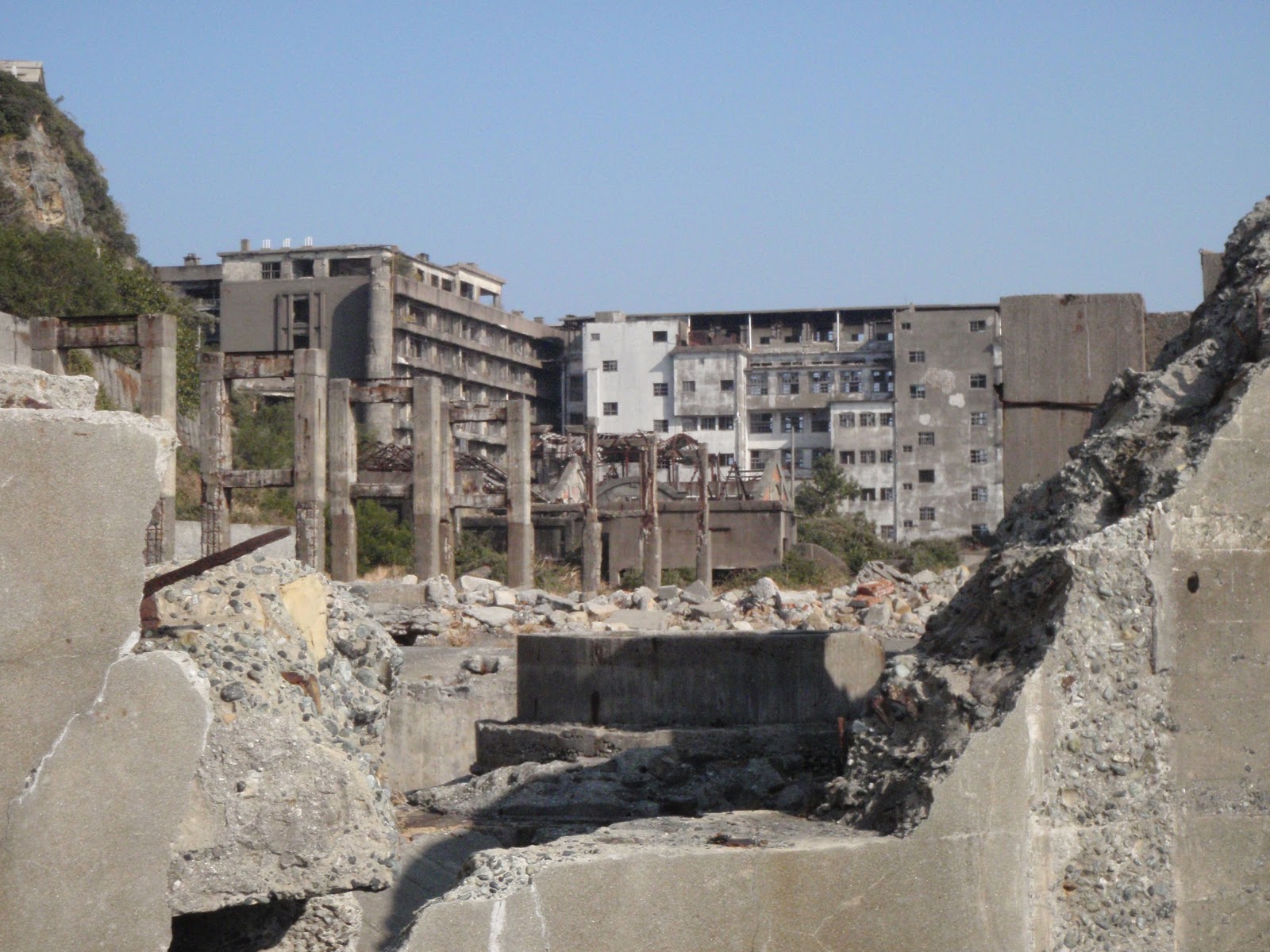
10:00 – Land on island - The island was used as a coal mining town from the late 1800's until it ran out of coal in 1974.  It was actually the most densely populated area on earth with a density of 216,264 people per square mile.  To put that in perspective, it was about three times the population density of Manhattan.  However, the island has now been completely abandoned for over 35 years.  I've never been to a ghost town before and I really enjoyed the tour.

The school was in the building on the right
Can you see why they call it "Battleship Island"?
11:00 – Leave island - The ferry provided some nice views of Nagasaki and the surrounding islands.

Nagasaki
12:00 – Arrive back in Nagasaki - We got some food and checked out the Lantern Festival in Hamanomachi Arcade.
2:00 – Arrive at Peace Park - The Peace Statue is the most well known part of this park.  His right hand points to the atomic bomb, while his left hand symbolizes eternal peace.  The hypocenter monument and the Fountain of Peace are also part of the Park.  We then made our way over to Urakami Cathedral ( 浦上天主堂 ).  This Cathedral was the largest church in East Asia at the time of the bombing, but was completely destroyed because it was located about one third of a mile from the hypocenter.  The church was rebuilt in 1959 and some of the surviving artifacts from the original church are on the grounds.  A piece of the original wall that was left standing is also on display next to the hypocenter monument.

Peace Statue
Urakami Cathedral with remnants of the old Cathedral
Hypocenter monument
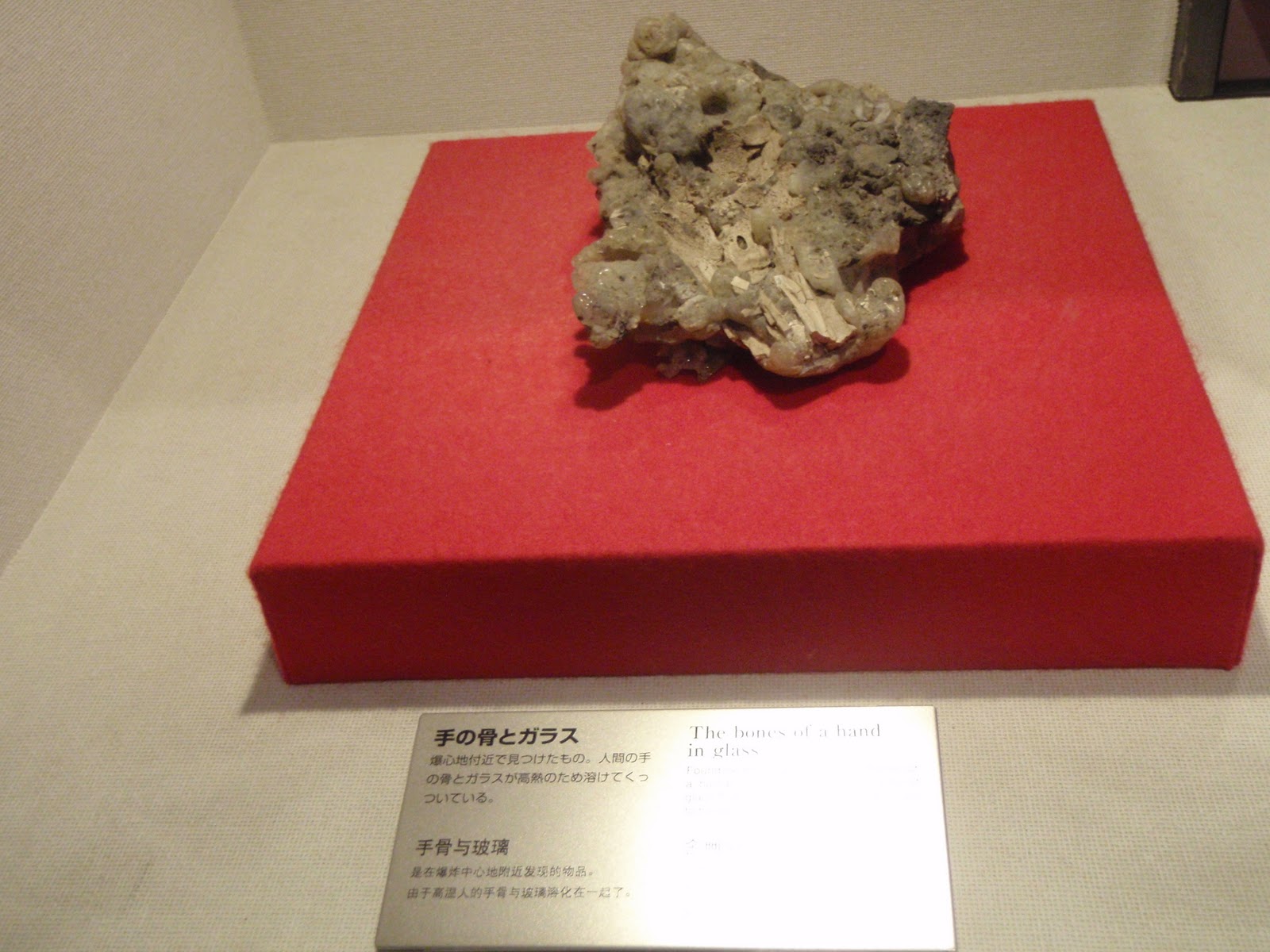
3:00 – Tour Atomic Bomb Museum ( 長崎原爆資料館 ) - Now this was just a depressing experience.  Don't get me wrong, I appreciated the history, but make sure you are really ready to subject yourself to an hour or two of stories and artifacts from one of the worst tragedies of all time.  Over 70,000 people died as a result of the blast and some of the pictures and stories are absolutely horrible.

A hand melted into glass
Angel recovered from Urakami Cathedral
Clock stopped at 11:02, the time the bomb hit
5:00 – Arrive at Sofuku Temple ( 崇福寺 ) - This is a Zen temple that was constructed in 1629 by Chinese residents.  As a result, this temple has much more Chinese influence than other temples in Japan.


Walking through the Lantern Festival on the way to the train station
7:30 – Leave Nagasaki
9:00 – Arrive in Tosu
9:30 – Leave Tosu
10:30 – Arrive in Kumamoto ( 熊本 )
11:00 – Arrive at Dyeing and Hostel Nakashimaya - We had some very good luck with hostels.  This place was a traditional Japanese style hostel, which meant sleeping on the floor.  It was pretty cool because I've never stayed in a traditional Korean or Japanese hostel before.
11:00 – 1:00 – Drink and food - Kumamoto had a really cool downtown area.
2:00 – Sleep

February 5th - Day 4
8:00 – Wake up - I should have woken up a little earlier.  After all, the agenda for day is a castle and a volcano.  There aren't many things cooler than castles and volcanoes. 
9:30 – Arrive at Kumamoto Castle ( 熊本城 ) - The castle dates to 1467 and is generally considered to be one of the three most famous castles in Japan.  The castle grounds also include Honmaru Goten Palace, which was constructed in 1610.
Kumamoto Castle
Honmaru Goten Palace
One of my favorite pictures since I've been in Asia
11:00 – Leave Castle
11:30 – Leave Kumamoto
12:45 – Arrive at Aso ( 阿蘇 ) - We both thought the views on the way to Aso were incredible.  Little did we know how amazing the volcano was going to be.
1:30 – Catch bus to mountain - Again, we thought the views on the bus ride were even better than the views from the train.  We still didn't know we were about to be blown away by this volcano (although not literally).
2:00 – Arrive at Mount Aso ( 阿蘇山 ) - I'm gonna let this sink in for a little bit before I officially make this claim, but as of right now I would say that this is the most amazing thing I have ever seen in my life.  I was truly in awe of being in the presence of one of the most destructive forces in the world.  Mount Aso is the largest active volcano in Japan and according to some sources has the largest caldera in the world. 

Wow
Panorama
Into the crater
I feel pretty small right now
5:00 – Leave Mount Aso - It was tough to leave this place
6:00 – Leave Aso
7:30 – Arrive in Kumamoto
8:00 – Leave Kumamoto
9:15 – Arrive in Fukuoka
10:30 – Arrive at Hakata Riverside Hostel - Now I'm used to hostels having horrible directions, but the directions for this place were just flat out wrong.  There were three sets of directions that all led to different places.  But I did manage to find it eventually.
11:00 to 3:00 – Eat and drink - It was Andrew's last night, so we stayed out pretty late.  We also got some late night food at a yatai, which is a food stall and one of the most well known symbols of Fukuoka. 

February 6th
7:30 – Wake up - I had a lot planned for the day.
8:15 – Arrive at Hakozaki Shrine ( 筥崎宮 ) - This shrine was founded in 923 AD and is another very well known shrine in Fukuoka.  I was on a pretty strict schedule so I didn't spend much time here.


9:15 – Depart Fukuoka
10:15 – Arrive at Space World - Not really that big of an attraction.  It's just a space-themed amusement park, but seeing as how it was on the way to Kokura I felt somewhat compelled to stop here.


10:45 – Depart Space World
11:00 – Arrive in Kokura ( 小倉 ) - Kokura seemed like a pretty nice city in the short time that I spent there.  An interesting fact about the city is that it was actually the intended target of the atomic bomb that hit Nagasaki, but due to cloud cover the bomber was forced to move on to the secondary target.

11:15 – Visit Kokura Castle ( 小倉城 ) - This castle was originally constructed in 1602, but it burned down in 1865.  Tiger paintings in the castle are very famous and were salvaged from the blaze.  The castle was eventually rebuilt in 1959.


11:45 – Leave Kokura
12:00 – Arrive in Mojiko ( 門司区 ) - I actually got off at the wrong train stop so this is why I spent so much time in Mojiko.  I did a lot of walkin.  My main reason for going to Mojiko was to see Kanmonkyo Bridge, which is one of the longest suspension bridges in the world and connects Kyushu with the mainland.
1:30 – Depart Mojiko
3:00 – Arrive in Hakata
3:15 – Leave Hakata
3:45 – Arrive in Dazaifu ( 太宰府 )
4:00 - Visit Dazaifu Tenmangu ( 太宰府天満宮 ) - This shrine was originally constructed in 905 AD.  It seemed cool, but it was absolutely packed with people.  I must have gone on some kind of holiday because I've never seen a shrine in Japan or Korea with that many people.

Bridge leading to the shrine
4:15 - Visit Kyushu National Musuem ( 九州国立博物館 ) - I didn't really care about going into the museum.  I had just seen a picture of the outside and I thought it looked like a pretty awesome building.


4:30 – Leave Dazaifu
5:00 – Arrive in Hakata
5:30 – Arrive at Fukuoka Castle Ruins - I saw the sunset here which was a pretty nice way to end the trip.  At this point I was pretty tired.
6:30 – Visit Canal City - It's a huge shopping area near my hostel.
8:00 – Call it a night - I was exhausted so I just stayed in and organized everything from my trip.
12:00 – Bedtime

February 7th
7:15 – Wake up - Still a little tired, but ready to head down to the ferry terminal
7:30 – Leave hostel
8:00 – Arrive at ferry terminal
9:00 – Depart Hakata - It's been fun, Japan.  I will be back in a few months and I can only hope that my second trip is as amazing as the first.
12:00 – Arrive in Busan - As much as I loved Japan, it is certainly nice to be back in Korea.  It's kind of starting to feel like home.
12:45 - Leave on KTX for Dongdaegu - This was the first time I took the KTX.  I guess after all the money I spent in Japan I figured what the hell.  The KTX is a beautiful train, but Korea has a ways to go to catch up with Japan's rail system.
1:30 - Arrive in Dongdaegu
1:45 - Leave Dongdaegu
2:15 - Arrive in Waegwan
2:30 - Home sweet home - It felt really good to just sit down in my chair and relax after constantly being on the move for the past week.

Top 5 Things I saw on my trip
1. Mt. Aso
2. Itsukushima
3. A-Bomb Dome
4. Atomic Bomb Museum
5. Kumamoto Castle

There's Japan in five days for ya.  This was possibly the best trip I've ever taken and I am really looking forward to seeing the Tokyo and Osaka regions in May.  As for my traveling in Korea, I think I'm gonna take next weekend to relax a little bit and plan some future trips. 

01 February 2011

Learn Korean: Basic Training

I've got to admit that I've lagged behind a little bit in learning Korean.  I've gotten completely caught up in traveling and reading that I kind of forgot that it's my responsibility to learn a little bit about the native language of this country.  I haven't gotten into anything like sentence structure, but I figured I would provide a list of basic words and phrases that may prove valuable if you ever venture over to Korea.  This is basically the stuff that I think would be useful on a day to day basis.

Note: If you can't see the Korean letters, click on the View tab at the top of your web browser.  Then click on Character Encoding, click on Customize Settings and enable Korean characters.

Alphabet
Let's start with the most basic part of learning Korean.  The alphabet.  The idea of learning an Asian alphabet systems seems like a daunting task, but in Korean it is actually quite easy.  I was able to memorize the letters before I came over and I've been able to sound out words since I've been here.  This can prove to be very useful when looking for places that are not listed in English.  It also provides some amusement when you come across Konglish, which are Korean words that are derived from English.  Some examples include 초콜릿, which sounds like cho-kol-lit or chocolate, and 텔레비전, which sounds like tel-le-bi-jeon or television.  The alphabet is made up of only 10 basic vowels and 14 basic consonants.  Doesn't seem too difficult, right?

The Korean writing system, which is currently called Hangul, was created in 1443 during the rule of King Sejong the Great.  Prior to the invention of Hangul, Koreans had used a system called Hanja, which was made up of Chinese symbols.  Hangul has been praised as one of the most logical languages in the world.

Korean Syllables
Letters from the alphabet are then combined to make syllables.  Each block of letters is one syllable.  For example, 산 is made up of three letters and is one syllable.  Each syllable must contain at least one consonant and one vowel.  There are five possible combinations of vowels and consonants in syllables.

1. The most basic is a syllable that only contains a vowel sound, such as the word "a" in English.  This would be written as 아 in Hangul.  A vowel can not be the first letter in a syllable, so the silent consonant ㅇ must be placed before the vowel.

2. The second possibility is a vowel sound followed by a consonant, such as 안 (an).  Again, ㅇ must be placed before the vowel.

3. There can be a consonant sound followed by a vowel sound.  An example would be 고 (go).  The silent consonant is not needed because there is already a consonant in front of the vowel.

4. A consonant followed by vowel, which is followed by a consonant.  Such is the case in 담 (dam). 

5. The last possibility is a consonant followed by a vowel followed by two consonants.  This is the most complicated because the sounds of some of the consonants seem to change and I'm not sure yet about the rules for this case.  An example is 홁.

Numbers
Koreans use two types of numbering systems: Native Korean numbers and Sino Korean numbers.  Native Korean numbers are used for counting and Sino Korean numbers are used for years, months, days, and money.  Since Koreans use Arabic numerals it isn't really essential to know the names of the numbers, but it can be helpful when ordering or paying.


Time and Dates


Useful Words and Phrases
This pretty much consists of stuff that have learned since I've been here or that I wish I had learned because it would have been very useful at one point or another.


That about sums up my crash course on Korean.  I just downloaded a beginner's book on Korean and I would really like to work my way through that.  My friends, coworkers, and students are all pretty eager to teach me Korean too, so I'm sure I will pick up plenty from them.  I will provide the disclaimer that I am learning this stuff as I post it, so I can't assure anyone that it is completely accurate.  Working my way through this stuff by typing it and romanizing it is probably helping me to learn Korean a lot more than it will help anyone reading this blog.