Showing posts with label Daejeon. Show all posts

22 March 2011

Buyeo

So I think I've finally gotten my fill of Baekje culture.  I headed up to Gongju (known as Ungjin during the time of the Baekje Kingdom) last month to get a glimpse of the city that served as Baekje's capital from 475 to 538.  As a follow up, I traveled to Buyeo (known as Sabi during the Baekje Kingdom) this weekend.  The capital was moved from Ungjin to Sabi in 538 and remained there until the fall of the Baekje Kingdom in 660.  Both places are pretty small (Gongju has a little over 100,000 people and Buyeo only has about 25,000), but they have nice historical sites and both provide enjoyable day trips for anyone interested in Korean history.  If you have to pick between the two, I would say Gongju is probably the better choice, but I had a good time exploring both of them.

I got into Buyeo by catching the 7:45 train out of Waegwan and getting into Daejeon around 9:15.  I then headed over to Seobu Bus Terminal and got a bus to Buyeo.  I ended up arriving in Buyeo around 11:15 and finally got to my first site, Jeongnimsaji, around noon.  Jeongnimsaji is a temple complex from the Baekje Kingdom and is particularly famous for a five-story stone pagoda, which survived the invasion of Sabi and actually details the exploits of the Silla and Tang forces as they conquered the Baekje Kingdom.  The site is also home to Jeongnim temple, which houses a stone Buddha statue from the Goryeo period.  A museum is also located on the site, but there really isn't too much to see.

Five-story pagoda and Jeongnimsa
Buddha statue located inside Jeongnimsa
Moving on from Jeongnimsaji, I headed over to the Buyeo National Museum.  The museums in Gongju and Buyeo are about the same size, but Gongju had a much more interesting outdoor display.  As for the inside, there were three things in Buyeo's museum that really caught my eye.  The first is a Baekje incense burner, which is prominently displayed and is obviously the highlight of the museum's collection.  I also really enjoyed the rock-carved Buddhist statues and the Avalokitesvara Bodhisattva statue.  Overall, the museum is definitely worth the price of admission (it's free) and they were doing lots of construction so it looks like they might be trying to expand the collection.

Baekje incense burner
Buddha statues
Avalokitesvara Bodhisattva
Moving on, I took a stroll to the outskirts of Buyeo to check out the Baekje Royal Tombs.  Again, I'm gonna have to compare these with the tombs at Gongju and say that Gongju's tombs were a little better.  There really wasn't much to the museum at this site.  However, the one advantage over Gongju is that they actually allow you to look inside some of the tombs and one of these tombs has restored paintings on the walls.

Inside one of the tombs
I traveled back into town after the viewing the tombs and arrived at Busosanseong, which was my final destination for the day.  This is the one place where I would definitely give the advantage to Buyeo.  There are numerous pavilions and shrines scattered throughout the fortress and the most famous site is Nakhwaam Rock.  Legend says that 3,000 women through themselves off of this rock after the fall of Baekje to avoid being captured by the Silla and Tang forces.

Artist depiction of the women who jumped off of the rock
Nakhwaam Rock
So that about sums up my day in Buyeo.  I'm planning to take off work this coming Friday and travel to Mt. Seorak for the weekend, which should provide some spectacular views.  I'm really looking forward to it, so wish me luck on that!

20 February 2011

Baekje History Tour

I've been trying to minimize the touring for rest of the month because I spent so much money in Japan and because I'm trying to gear up for all of the traveling I am planning to do in the spring.  However, it's impossible for me to completely stop traveling, so this weekend I visited Gongju ( 공주 ).  This is a town/city of about 125,000 people and it's claim to fame is that it was the capitol of the Baekje Kingdom from 475 to 538.  Since I just wrote an article on the history of Baekje last week, I figured this was as good of a time as any to visit this historical place.  I recently updated my Baekje post, along with a couple other posts, to include some of the pictures that I took this weekend.

I woke up around 6:45 on Saturday in order to catch the 7:45 train to Daejeon.  Unfortunately, Gongju does not have a train station, so I had to take a 20 minute stroll from Daejeon train station to the intercity bus terminal.  The bus from Daejeon to Gongju is a little over an hour, so I ended up doing quite a bit of traveling on Saturday.  I got into to Gongju around noon and headed off to my first destination: Gongsanseong.

Gongsanseong ( 공산성 )
This is a mountain fortress that is located along the Geum river ( 금강 ) and contains many monuments and pavilions.  Yeonggeun temple ( 영근사 ) is also located within the fortress.  The fortress was constructed during the rule of the Baekje Kingdom and is one of the most famous Baekje fortresses.  It was originally made of mud and called Unjinseong ( 운진성 ), but was later renovated with stone during the Joseon Dynasty and given its current name.  So, let's head through Geumseoru Gate and start the tour!

Geumseoru Gate Pavilion ( 공산성 금서루 ) with numerous steles in front
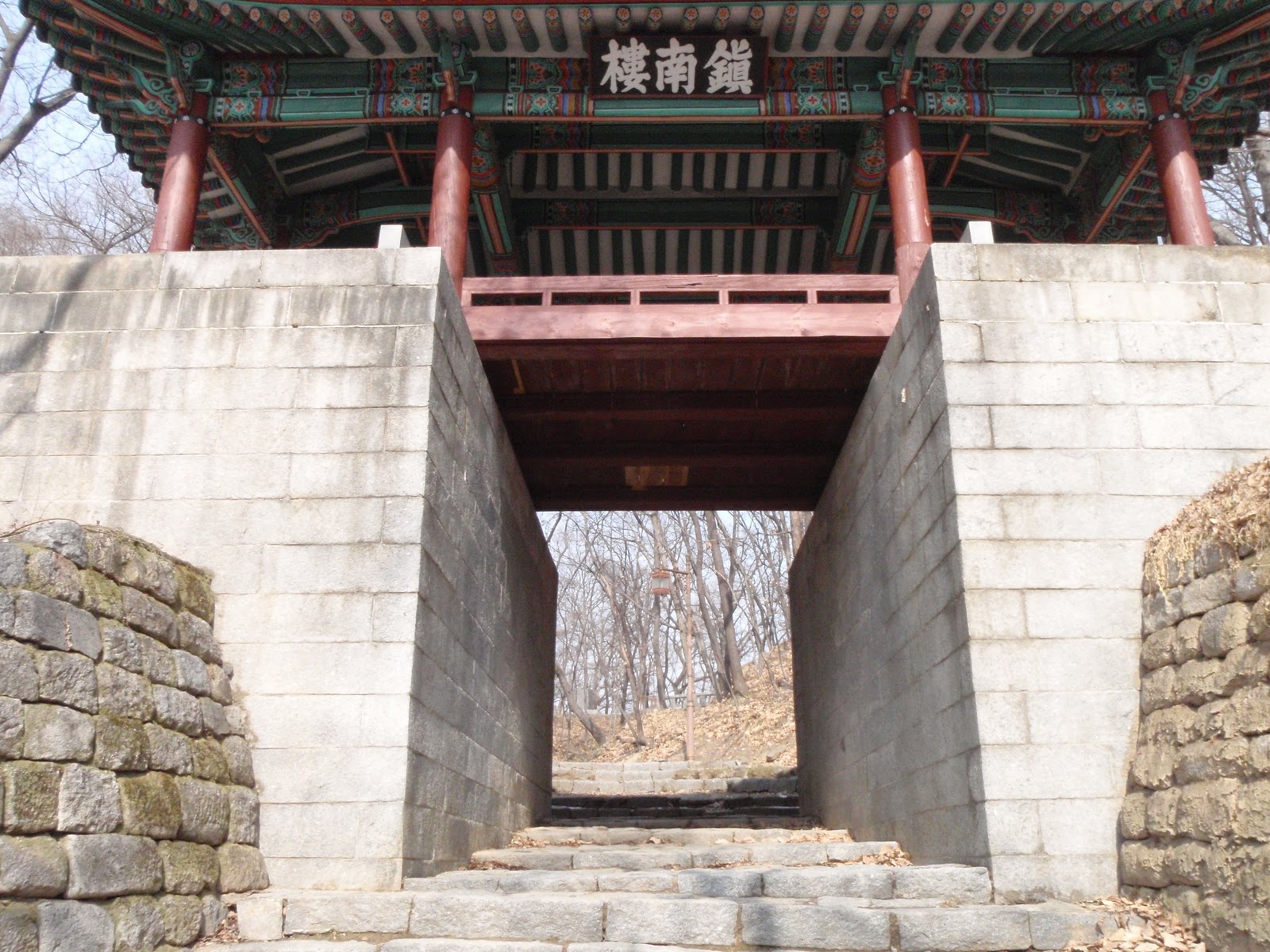
There are a couple different paths to choose from, but I chose to make a right and head over toward Jinnamnu Gate.  I stopped at the Twin Tree Pavilion on the way, but I wasn't too impressed.  From Jinnamnu Gate I backtracked a little bit and went toward the river to find Yeongeun Temple.  This was a pretty nice place and had a beautiful view of the river.  Manharu Pavilion and a lotus pond are situated in front of the temple.

Jinnamnu Gate Pavilion ( 공산성 진남루 )
Inside one of the buildings at Yeongeunsa ( 영은사 )
After leaving Manharu, I walked along the fortress wall for a little bit until I found my way to Imnyugak Pavilion.  Other than the wall that surrounds the fortress, this was probably the most impressive structure at Gongsanseong.  I then continued my walk along the wall and passed the Yeongdongnu Gate Pavilion on my way back to Jinnamnu.  From Jinnamnu, I then walked to the front gate. 

Imnyugak Pavilion ( 임류각 )
Yeongdongnu Gate Pavilion ( 공산성 영동루 )
After arriving back at the front gate, I took a short trek up to Gongsanjeong Pavilion, which provided some beautiful views of the city.  Then I was on my way to the next destination.

Passed this guy on the way
Gongsanjeong Pavilion ( 공산정 )
Songsanri ( 송산리 )
Songsanri is about a 15 minute walk from Gongsanseong and is the site of 7 royal tombs from the Baekje Kingdom.  The most famous of these is the tomb of King Muryeong, which was the only tomb that had not been robbed prior to discovery.  It actually wasn't uncovered until 1971 when digging began for the installation of a water drainage system.  King Muryeong ruled from 501 until 523 and the unearthing of his tomb provided a lot of insight into Baekje culture during the time of his reign.  There were actually 4,600 objects recovered from his tomb!  The site of Songsanri contains a walking path around the tombs as well as a museum that contains some of the artifacts from the tomb.  Here are some of things to see:

Mural on the wall of the No. 6 tomb

King's gold diadem ornaments, gold chignon ornaments, and gold earrings
Queen's gold diadem ornaments, gold necklaces, gold earrings, and gold and silver bracelets
Royal Tombs
Gongju National Museum ( 국립공주박물관 )
The museum is very close to the tombs and there is actually a nice walking path through the woods that takes about 10 minutes.  The museum opened in 1940 and houses over 20,000 historical pieces.  The museum focuses on Baekje history, but it also has artifacts uncovered from the surrounding areas that date to other periods in Korean history.  The museum has an outdoor collection and a two-floor permanent exhibition.  The first floor is dedicated to the tomb of King Muryeong and the second floor has galleries dedicated to the Prehistoric era, Baekje, and Unified Silla. 

Gongju National Museum and the outdoor gallery
Queen's headrest
King's headrest
Silver cup with bronze stand
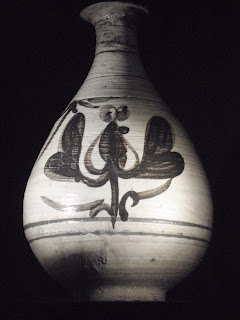
Joseon Jar
Stone daggers
Baekje Quiver
Gilt-bronze
Boddhisattva
Stone Seated Buddha
This was my last stop on the tour of Gongju, so I found my way back to the bus terminal.  On the way back I happened to see some guys flying around in powered parachutes.  These are parachutes with seats that have a fan attached to the back.  The thing I was most amazed by was that the contraption actually generated lift when the fan was pointed toward the ground.  I have no idea how powerful the fan was, but the guys were flying around for at least 15 or 20 minutes.  I was pretty impressed and I definitely wouldn't mind taking a ride in one of those.

30 January 2011

Science AND Ancient History? Sign Me Up!

Note: I visited some museums this weekend and as a result I got some pictures to put in some of my history blogs.  So I've updated my Prehistory and Confederated Kingdoms posts and I also replaced a picture on my Busan post that I had taken from Wikipedia.  Now every picture on this blog has been taken by me.

I finally made my way to Daejeon this weekend.  December 26th was actually my originally planned date for the trip, but for multiple reasons it got pushed back to January 29th.  It was a little bit of a nerdy trip in that I visited quite a few museums, but I had a lot of fun.

I got into Daejeon around 10:15 and hopped on the subway to go to Seattle Park.  The park really wasn't anything special, but I felt a little bit of an obligation to go see it because of the name.  I then walked my way up to EXPO Park, which was the sight of the 1993 Daejeon Expo.  This place is kind of an amusement park combined with a science center.  It was pretty fun to tour around because it had quite a few unique buildings.


I then crossed the highway to wander around the National Science Museum.  The museum featured a little bit of everything.  It had a planetarium, exhibits on animals, displays of ancient Korean culture, and even a military exhibition.  I really enjoyed it and I think anyone interested in science would probably enjoy it as well.  It's nowhere near as extensive as the Smithsonian, but it still provides some interesting facts and a pleasant diversion from city life.

Mobius strip in front of National Science Museum
Can you guess what Korean words are for seconds, minutes, days and years?  I'll give you a hint.  It takes 8 minutes and 20 seconds for light from the sun to reach earth
I actually didn't really end up getting lost on this trip.  I found my way to the Currency Museum after I left the science center.  This place was okay, but I wasn't really expecting too much to begin with.  It basically commemorates Korean currencies throughout the years and also investigates currencies from around the world.  I toured it pretty quickly, but I enjoyed the time I spent there.


My only long trek of the day took place between the Currency Museum and Daejeon World Cup Stadium.  This stadium didn't really stack up to the one I saw in Daegu.  It was okay, but not something worth going out of my way.  Luckily, the Daejeon Prehistoric Museum was close by and I ended up getting some great pictures for my blog from the displays.  The museum covers the Paleolithic Age, Neolithic Age, Bronze Age, and Iron Age. 
Scene from the Bronze Age
So that about rounded out my day in Daejeon.  I ended up heading back to Waegwan at 6:15 and going out in Gumi on Saturday night.  I had fun on the trip, but my Japan trip is really what I'm excited for at this point.  I can't wait to set sail for "The Land of the Rising Sun" on Wednesday.